The American text-book of operative dentistry / In contributions of eminent authorities. Ed. by Edward C. Kirk.
- Edward Cameron Kirk
- Date:
- 1900
Licence: Public Domain Mark
Credit: The American text-book of operative dentistry / In contributions of eminent authorities. Ed. by Edward C. Kirk. Source: Wellcome Collection.
Provider: This material has been provided by the Augustus C. Long Health Sciences Library at Columbia University and Columbia University Libraries/Information Services, through the Medical Heritage Library. The original may be consulted at the the Augustus C. Long Health Sciences Library at Columbia University and Columbia University.
101/864 (page 99)
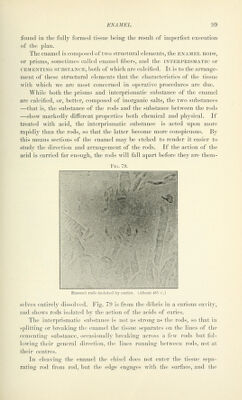
![found in the fully formed tissue being the result of imperfect execution of the plan. The enamel is coni])()sed of two structural elements, the enamel rods, or prisms, sometimes called enamel fibers, and the interpeismatic or CEMENTING SUBSTANCE, both of which are calcified. It is to the arrange- ment of these structural elements that the characteristics of the tissue with \\hich we are most concerned in operative procedures are due. While both the prisms and interprismatic substance of the enamel are calcified, or, better, composed of inorganic salts, the two substances —that is, the substance of the rods and the substance between the rods —show markedly different properties both chemical and physical. If treated with acid, the interprismatic substance is acted upon more rapidly than the rods, so that the latter become more conspicuous. By this means sections of the enamel may be etched to render it easier to study the direction and arrangement of the rods. If the action of the acid is carried far enough, the rods will fall apart before they are them- FiG. 79. Enamol roils isolatL'd Ijv caries. (About li selves entirely dissolved. Fig. 79 is from the debris in a carious cavity, and show^s rods isolated by the action of the acids of caries. The interprismatic substance is not as strong as the rods, so that in splitting or breaking the enamel the tissue separates on the lines of the cementing sul)stance, occasionally breaking across a few rods but fol- lowing their general direction, the lines running between rods, not at their centres. In cleaving the enamel the eiiisel does not enter the tissue sepa- rating rod from rod, but the edge engages with the surface, and the](https://iiif.wellcomecollection.org/image/b21216629_0101.jp2/full/800%2C/0/default.jpg)