The American text-book of operative dentistry / In contributions of eminent authorities. Ed. by Edward C. Kirk.
- Edward Cameron Kirk
- Date:
- 1900
Licence: Public Domain Mark
Credit: The American text-book of operative dentistry / In contributions of eminent authorities. Ed. by Edward C. Kirk. Source: Wellcome Collection.
Provider: This material has been provided by the Augustus C. Long Health Sciences Library at Columbia University and Columbia University Libraries/Information Services, through the Medical Heritage Library. The original may be consulted at the the Augustus C. Long Health Sciences Library at Columbia University and Columbia University.
135/864 (page 133)
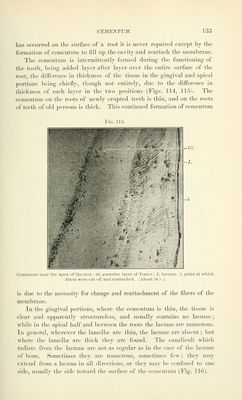
![has occurred on the surfiice of a root it is never repaired except by the formation of cementum to fill up the cavity and reattach the membrane. The cementum is intermittently formed during the functioning of the tooth, being added layer after layer over the entire surface of the root, the difference in thickness of the tissue in the gingival and apical portions being chiefly, though not entirely, due to the difference in thickness of each layer in the two positions (Figs. 114, 115). The cementum on the roots of newly erupted teeth is thin, and on the roots of teeth of old persons is thick. This continued formation of cementum Fig. 115. Cementum near tbe apex of the root: Gl, granular layer of Tomes ; i, lacuufe , /;, point at which fibers were cut off and reattached. (About 54 X.) is due to the necessity for change and reattachment of the fibers of the membrane. In the gingival portions, where the cementum is thin, the tissue is clear and a])parently structureless, and usually contains no lacuna?; while in the apical half and between the roots the lacunte are numerous. In general, wherever the lamellie are thin, the lacunae are absent; but where the lamellae are thick they are found. The canalicuH which radiate from the lacunae are not as regular as in the case of the lacunie of bone. Sometimes they are numerous, sometimes few; they may extend from a lacuna in all directions, or they may be confined to one side, usually the side toward the surface of the cementum (Fig. 116).](https://iiif.wellcomecollection.org/image/b21216629_0135.jp2/full/800%2C/0/default.jpg)