The American text-book of operative dentistry / In contributions of eminent authorities. Ed. by Edward C. Kirk.
- Edward Cameron Kirk
- Date:
- 1900
Licence: Public Domain Mark
Credit: The American text-book of operative dentistry / In contributions of eminent authorities. Ed. by Edward C. Kirk. Source: Wellcome Collection.
Provider: This material has been provided by the Augustus C. Long Health Sciences Library at Columbia University and Columbia University Libraries/Information Services, through the Medical Heritage Library. The original may be consulted at the the Augustus C. Long Health Sciences Library at Columbia University and Columbia University.
142/864 (page 140)
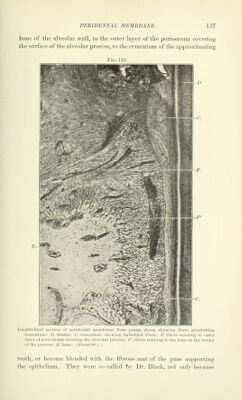
![gingival line the fibers arc inclined slightly apically, passing over the border of the jn'ocess to be attached to the outer layer of the ])eriosteuni. These fibers are specially large and strong. Just at the rim of the alveolus the fibers are inclined slightly apically and are inserted into the bone, forming the edge of the process. In transverse sections of the membrane in the gingival portion (Fig. 121) the fibers spring from the cementum in large bundles ; at the centre of the labial surface they extend directly outward, breaking uj) into smaller bundles, })assing around bloodvessels and bundles of fibers, and blending with the fibrous tissue supporting the epithelium. Passing niesially and distally toward the corners of the root, the fibers swing around laterally and pass to the cementum of the next tooth. On the Fi(i. 1-22. Fibers at tlie border of the alveolar process (from sheep): D, dentin ; C, cementum; F, fibers ex- tending from cementum to bone; Bl, bloodvessel; B, bone. (About 80 X.) a]>proximal sides the fibers suddenly divide into smaller bundles, M'hich wind in and out around bloodvessels, and bundles of fibers which pass into the gingivus and are reunited into laroe l)undles to be inserted into the cementum of the next tooth. On the lingual side the arrangement is like that of the labial, except that the distance to wliich the fibers of the membrane can be followed before they are lost in the fibrous mat of the gum is usually greater than on the labial. In the occlusal third of the alveolar portion of the membrane the fibers pass, at right angles to the axis of the tooth, directly from the cementum to the bone. In this position the fibers are large and do not break u]i into smaller bundles, but the original fibers can be followed](https://iiif.wellcomecollection.org/image/b21216629_0142.jp2/full/800%2C/0/default.jpg)