The American text-book of operative dentistry / In contributions of eminent authorities. Ed. by Edward C. Kirk.
- Edward Cameron Kirk
- Date:
- 1900
Licence: Public Domain Mark
Credit: The American text-book of operative dentistry / In contributions of eminent authorities. Ed. by Edward C. Kirk. Source: Wellcome Collection.
Provider: This material has been provided by the Augustus C. Long Health Sciences Library at Columbia University and Columbia University Libraries/Information Services, through the Medical Heritage Library. The original may be consulted at the the Augustus C. Long Health Sciences Library at Columbia University and Columbia University.
34/864 (page 32)
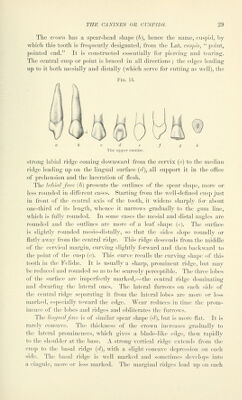
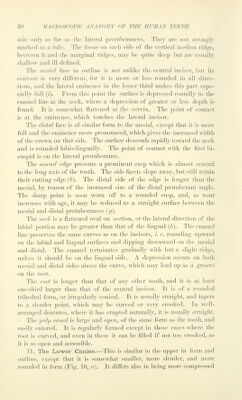
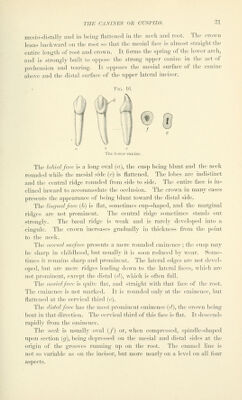
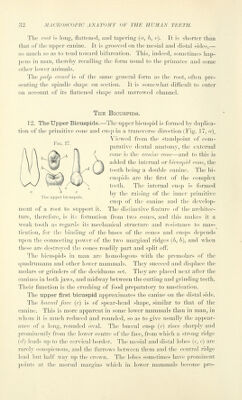
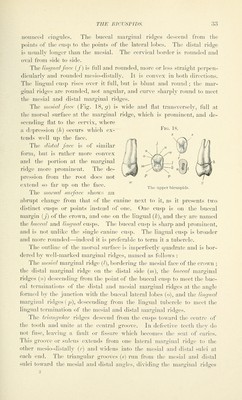
![Tli(> roof is long:, iiattencd, and tapering [a, b, c). It is shdrtcr tlum that ot'the up])or canine. It is grooved on tlie mesial and distal sides,— so niueh so as to tend toward bifurcation. This, indeed, sometimes hap- ])ens in man, thereby recalling the ibrm usual to the primates and some other lower animals. T\w jjtt/jj c((ii(i/\i^ of the same general I'onii as the root, often ])re- senting the spindle shape on section. It is somew hat dilVieult to enter on acconnt of its flattened sha})e and narrowed channel. The upper bicuspids. nient of a root to snpport it. The Bicuspids. 12. The Upper Bicuspids,—The npper bicuspid is formed bv duplica- tion of the primitive cone and cusp in a transverse direction (Fig. 17, a). Viewed from the standpoint of com- l)arative dental anatomy, the external cone is the canine cone—and to this is added the internal or bicuspkl cone, the tooth being a donble canine. The bi- cuspids are the first of the complex teeth. The internal cusp is formed by the raising of the inner primitive cusp of the canine and the develop- The distinctive featiu'c of the architec- ture, therefore, is its formation from two cones, and this makes it a weak tooth as regards its mechanical structure and resistance to mas- tication, for the binding of the bases of the cones and cusps depends upon the connecting power of the two marginal ridges (6, h), and when these are destroyed the cones readily part and split off. The bicuspids in man are homologous with the premolars of the quadrumana and other lower mammals. They succeed and displace the molars or grinders of the deciduous set. They are placed next after the canines in both jaws, and midway between the cutting and grinding teeth. Their function is the crushing of food preparatory to mastication. The upper first bicuspid approximates the canine on the distal side. The buccal face (c) is of spear-head shape, similar to that of the canine. This is more apparent in some lower mammals than in man, in whom it is much reduced and rounded, so as to give usually the a])])ear- ance of a long, rounded oval. The buccal cusp (c) rises sharply and prominently from the lower centre of the face, from which a strong ridge {(T) leads up to the cervical border. The mesial and distal lobes {e, e) are rarely conspicuous, and the furrows between them and the central ridge lead but half way up the crown. The lobes sometimes have prominent points at the morsal margins which in lower mammals become pro-](https://iiif.wellcomecollection.org/image/b21216629_0034.jp2/full/800%2C/0/default.jpg)