The American text-book of operative dentistry / In contributions of eminent authorities. Ed. by Edward C. Kirk.
- Edward Cameron Kirk
- Date:
- 1900
Licence: Public Domain Mark
Credit: The American text-book of operative dentistry / In contributions of eminent authorities. Ed. by Edward C. Kirk. Source: Wellcome Collection.
Provider: This material has been provided by the Augustus C. Long Health Sciences Library at Columbia University and Columbia University Libraries/Information Services, through the Medical Heritage Library. The original may be consulted at the the Augustus C. Long Health Sciences Library at Columbia University and Columbia University.
40/864 (page 38)
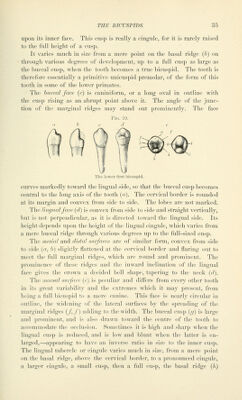
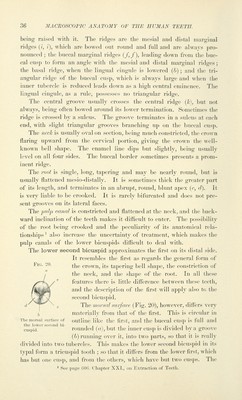
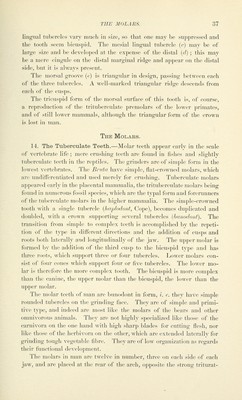
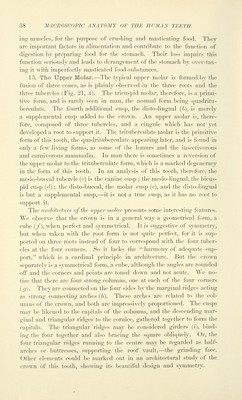
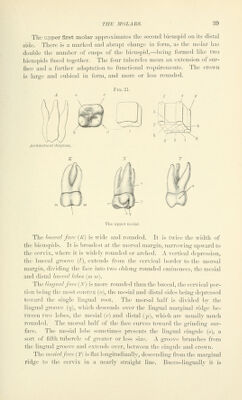
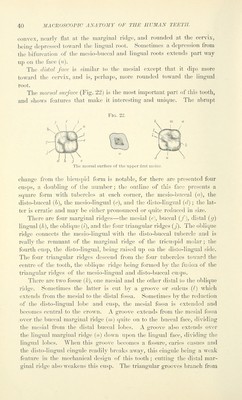
![\uvr muscles, fur the ])urpose of cnisliiiiu' and masticating; I'ood. Thoy arc im})ortant factors in alimentation and contribute to the function of digestion by preparing ibod for the stomach. Their loss imjiairs this function seriously and leads to derangement of the stomach by over-tax- ing it with imperfectly masticated food-substances. 15. The Upper Molar.—The typical U])})er molar is formed by the fusion of three cones, as is plainly observed in the three roots and the three tubercles (Fig. 21, A). The tricuspid molar, therefore, is a jirimi- tive form, and is rarely seen in man, the normal form being quadritu- berculate. The fourth additional cusp, the disto-lingual {b), is merely a supplemental cusp added to the crown. An upper molar is, there- fore, composed of three tubercles, and a cingule which has not yet developed a root to support it. The tritubereulate molar is the primitive form of this tooth, the quadrituberculate appearing later, and is found in onlv a iew liviup; forms, as some of the lemurs and the insectivorous and carnivorous mammalia. In man there is sometimes a reversion of the upper molar to the tritubereulate form, which is a marketl degeneracy in the form of this tooth. In an analysis of this tooth, therefore, the mesio-buccal tubercle (c) is the canine cusp ; the mesio-lingual, the bicus- pid cusp [d); the disto-buccal, the molar cusp {e), and the disto-lingual is but a supplemental cusp,—it is not a true cusp, as it has no root to support it. The architecture of the upper molar presents some interesting features. We observe that the crown is in a general way a geometrical form, a cube (/), wdien perfect and symmetrical. It is suggestive of symmetry, but when taken with the root form is not quite perfect, for it is sup- ported on three roots instead of four to correspond with the four tuber- cles at the four corners. So it lacks the harmony of adequate sup- port, which is a cardinal principle in architecture. But the crown separately is a symmetrical form, a cube, although the angles are rounded off and the corners and ])oints are toned down and not acute. We no- tice that there are four strong columns, one at each of the four corners (fj). They are connected on the four sides by the marginal ridges acting as strong connecting arches (h). These arches are related to the col- umns of the crown, and both are impressively proportioned. The cusps may be likened to the capitals of the columns, and the descending mar- ginal and triangular ridges to the cornice, gathered together to form the capitals. The triangular ridges may be considered girders (i), bind- ing the four together and also bracing the square obliquely. Or, the four triangular ridges running to the centre may be regarded as half- arches or buttresses, supporting the roof vault,—the grinding face. Other elements could be marked out in an architectural study of the crown of this tooth, showing its beautiful design and symmetry.](https://iiif.wellcomecollection.org/image/b21216629_0040.jp2/full/800%2C/0/default.jpg)