The American text-book of operative dentistry / In contributions of eminent authorities. Ed. by Edward C. Kirk.
- Edward Cameron Kirk
- Date:
- 1900
Licence: Public Domain Mark
Credit: The American text-book of operative dentistry / In contributions of eminent authorities. Ed. by Edward C. Kirk. Source: Wellcome Collection.
Provider: This material has been provided by the Augustus C. Long Health Sciences Library at Columbia University and Columbia University Libraries/Information Services, through the Medical Heritage Library. The original may be consulted at the the Augustus C. Long Health Sciences Library at Columbia University and Columbia University.
709/864 (page 707)
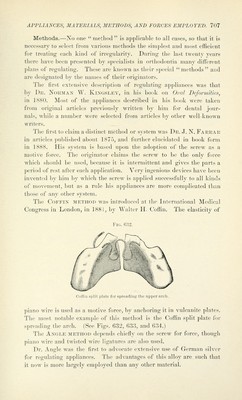
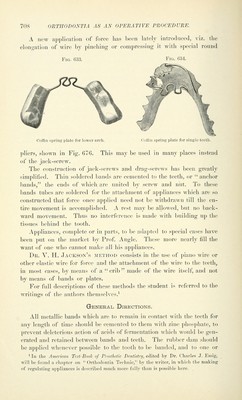
![Methods.—Xo one '^ method is applicable to all cases, so that it is necessary to select from various methods the simj)lest and most efficient for treating each kind of irregularity. During the last twenty years there have been presented by specialists in orthodontia many different plans of regulating. These are known as tlieir special methods and are designated by the names of their originators. The first extensive description of regulating appliances was that by Dr. Noemax W. Kixgsley, in his book on Oral Deformities, in 1880. Most of the appliances described in his book were taken from original articles previously written by him for dental jour- nals, while a number were selected from articles by other well-known writers. The first to claim a distinct method or system was Dr. J. N. Farrar in articles published about 1875, and further elucidated in book form in 1888. His system is based upon the adoption of the screw as a motive force. The originator claims the screw to be the only force which should be used, because it is intermittent and gives the parts a period of rest after each application. Very ingenious devices have been invented by him by wliich the screw is applied successfully to all kinds of movement, but as a rule his appliances are more complicated than those of any other system. The Coffin method was introduced at the International Medical Congress in London, in 1881, by Walter H. Coffin. The elasticity of Fk;. fi.'^-J. Cofliu split plate for spreading the upper arch. piano wire is used as a motive force, by anchoring it in vulcanite plates. The most notable exam])le of this method is the Coffin split plate for spreading the arch. (See Figs. 632, 633, and 634.) The Angle method depends chiefly on the screw for force, though piano wire and twisted wire ligatures are also used. Dr. Angle M'as the first to advocate extensive use of German silver for regulating appliances. The advantages of this alloy are such that it now is more largely employed than any other material.](https://iiif.wellcomecollection.org/image/b21216629_0709.jp2/full/800%2C/0/default.jpg)