The American text-book of operative dentistry / In contributions of eminent authorities. Ed. by Edward C. Kirk.
- Edward Cameron Kirk
- Date:
- 1900
Licence: Public Domain Mark
Credit: The American text-book of operative dentistry / In contributions of eminent authorities. Ed. by Edward C. Kirk. Source: Wellcome Collection.
Provider: This material has been provided by the Augustus C. Long Health Sciences Library at Columbia University and Columbia University Libraries/Information Services, through the Medical Heritage Library. The original may be consulted at the the Augustus C. Long Health Sciences Library at Columbia University and Columbia University.
712/864 (page 710)
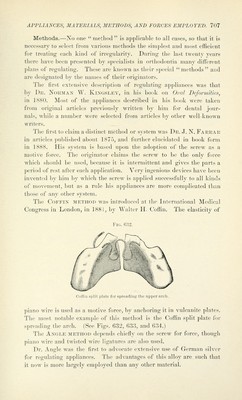
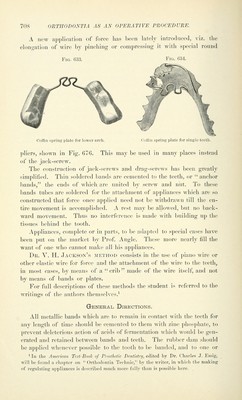
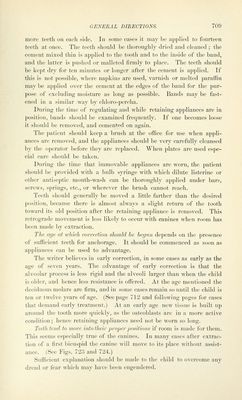
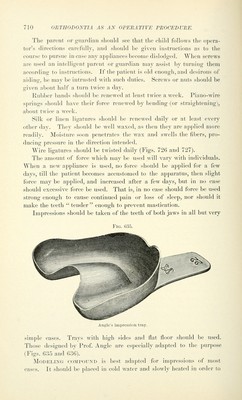
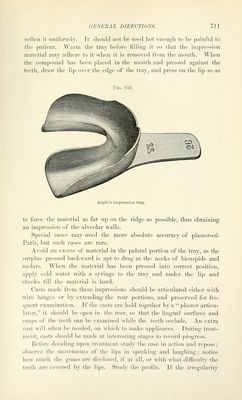
!['V\\v parent or Liiiardiaii should sec tliat the child follows the opera- tor's directions carcfnlly, and should be given instructions as to the course to pursue in case any appliances become dislodged. Wiicn screws are used an intelligent parent or guardian may assist by turning them according to instructions. If the ])aticnt is old enough,and desirous of aiding, he may be intrusted with such duties. Screws or nuts should be given about half a turn twice a da}-. Rul)ber bands shoidd be renewed at least twice a week. I'iano-wire springs should have their force renewed by bending (or straightening), about twice a week. Silk or linen ligatures should be renewed daily or at least every other dav. They should be well waxed, as then they are applied more readily. Moisture soon penetrates the wax and swells the fibers, pro- ducing pressure in the direction intended. Wire ligatures should be twisted daily (Figs. 726 and 727). The amount of force which may be used will vary with individuals. When a new appliance is used, no force should be applied for a few days, till the patient becomes accustomed to the apparatus, then slight force may be applied, and increased after a few days, but in no case should excessive force be used. That is, in no case should force be used strong enough to cause continued pain or loss of sleep, nor should it make the teeth tender enough to prevent mastication. Impressions should be taken of the teeth of both jaws in all but very Angle's impression tray. simple cases. Trays with high sides and flat floor should be used. Those designed by Prof. Angle are especially adapted to the purpose (Figs. 635 and 636). Modeling compound is best adapted for impressions of most cases. It should be placed in cold water and slowly heated in order to](https://iiif.wellcomecollection.org/image/b21216629_0712.jp2/full/800%2C/0/default.jpg)