The American text-book of operative dentistry / In contributions of eminent authorities. Ed. by Edward C. Kirk.
- Edward Cameron Kirk
- Date:
- 1900
Licence: Public Domain Mark
Credit: The American text-book of operative dentistry / In contributions of eminent authorities. Ed. by Edward C. Kirk. Source: Wellcome Collection.
Provider: This material has been provided by the Augustus C. Long Health Sciences Library at Columbia University and Columbia University Libraries/Information Services, through the Medical Heritage Library. The original may be consulted at the the Augustus C. Long Health Sciences Library at Columbia University and Columbia University.
713/864 (page 711)
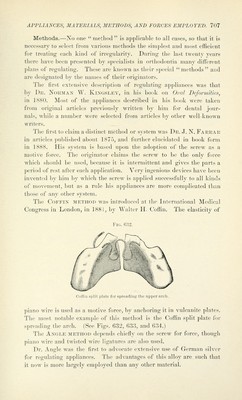
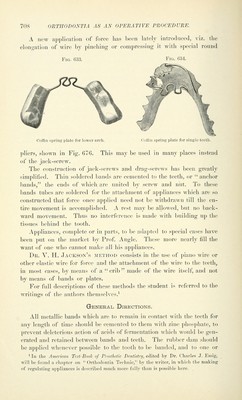
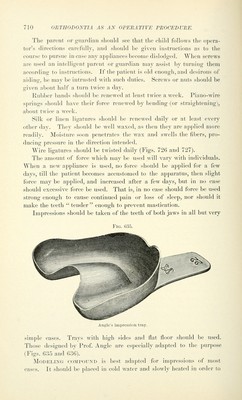
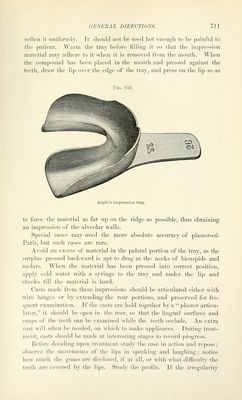
![soften it uniformly. It slioiikl not he used hot enong-h to he painful to the patient. Warm the tray hefore fillino' it so that the impression material may adhere to it Avhen it is removed from the mouth. AVhen the compound has been placed in the moutli and pressed against the teeth, draw the lip over the edge of the tray, and press on the lip so as Fig. 636. Angle'.s impression tray. to force the material as far up on the ridge as possible, thus obtaining an impression of the alveolar walls. Special cases may need the more absolute accuracy of plaster-of- Paris, but such cases are rare. Avoid an excess of material in the palatal portion of the tray, as the surplus pressed backward is apt to drag at the necks of bicuspids and molars. When the material has been pressed into correct position, ajiply cold water with a syringe to the tray and under the lip and cheeks till the material is hard. Casts made from these impressions should be articulated either with wire hinges or by extending the rear portions, and preserved for fre- quent examination. If the casts are held together by a '' plaster articu- lator, it should be open in the rear, so that the lingual surfaces and cusps of the teeth can be examined w hile the teeth occlude. An extra east will often be needed, on which to make ap])liances. During treat- ment, casts should be made at interesting stages to record progress. Before deciding upon treatment study the case in action and repose; observe the movements of the lips in speaking and laughing; notice how much the gums are disclosed, if at all, or with what diilieultv the teeth are covered by the lips. Study the profile. If the irregularitv](https://iiif.wellcomecollection.org/image/b21216629_0713.jp2/full/800%2C/0/default.jpg)