The American text-book of operative dentistry / In contributions of eminent authorities. Ed. by Edward C. Kirk.
- Edward Cameron Kirk
- Date:
- 1900
Licence: Public Domain Mark
Credit: The American text-book of operative dentistry / In contributions of eminent authorities. Ed. by Edward C. Kirk. Source: Wellcome Collection.
Provider: This material has been provided by the Augustus C. Long Health Sciences Library at Columbia University and Columbia University Libraries/Information Services, through the Medical Heritage Library. The original may be consulted at the the Augustus C. Long Health Sciences Library at Columbia University and Columbia University.
716/864 (page 714)
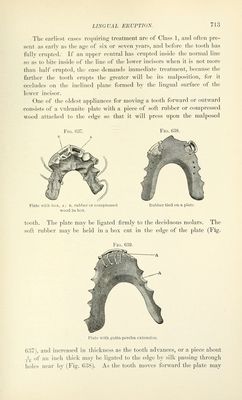
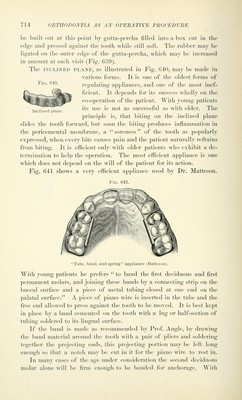
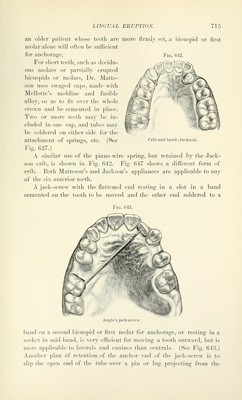
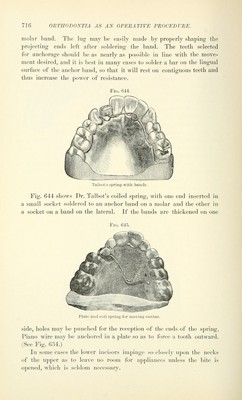
![Fig. 640. be built out at this ])()iut by gutta-])crcha filled iuto a box cut in the edtj^e and ])ress('d at2:ainst the tooth while .still soft. Tiie rubber may be ligated on the outer edue of the gutta-percha, which may be increased in amount at each visit (Fig. 639). The I^X'LINED pi.anp:, as illustrated in Fig. 640, may be made in various forms. It is on(» of the oldest forms of regulating appliances, and one of the most inef- ficient. It depends for its success wholly on the co-operation of the patient. With young })atients its use is not as successful as with older. The principle is, that biting on the inclined plane slides the tooth forward, but soon the biting produces inflammation in the pericemental membrane, a soreness of the tooth as pojmlarly expressed, when every bite causes pain and the patient naturally refrains from biting. It is efficient only with older patients who exhibit a de- termination to help the operation. The most efficient appliance is one which does not depend on the will of the patient for its action. Fig. 641 shows a very efficient appliance used by Dr. Matteson. Fig. 641. Tube, band, and spring appliance (Matteson). With young patients he prefers to band the first deciduous and first permanent molars, and joining these bands by a connecting strip on the buccal surface and a piece of metal tubing closed at one end on the palatal surface. A piece of piano wire is inserted in the tube and the free end allowed to press against the tooth to be moved. It is best kept in place by a band cemented on the tooth with a lug or half-section of tubing soldered to its lingual surface. If the band is made as recommended by Prof. Angle, by drawing the band material around the tooth with a pair of pliers and soldering together the projecting ends, this projecting portion may be left long enough so that a notch may be cut in it for the piano wire to rest in. In many cases of the age under consideration the second deciduous molar alone will be firm enough to be banded for anchorage. With](https://iiif.wellcomecollection.org/image/b21216629_0716.jp2/full/800%2C/0/default.jpg)