The American text-book of operative dentistry / In contributions of eminent authorities. Ed. by Edward C. Kirk.
- Edward Cameron Kirk
- Date:
- 1900
Licence: Public Domain Mark
Credit: The American text-book of operative dentistry / In contributions of eminent authorities. Ed. by Edward C. Kirk. Source: Wellcome Collection.
Provider: This material has been provided by the Augustus C. Long Health Sciences Library at Columbia University and Columbia University Libraries/Information Services, through the Medical Heritage Library. The original may be consulted at the the Augustus C. Long Health Sciences Library at Columbia University and Columbia University.
720/864 (page 718)
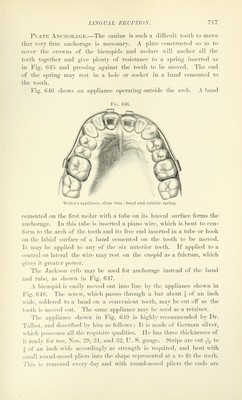
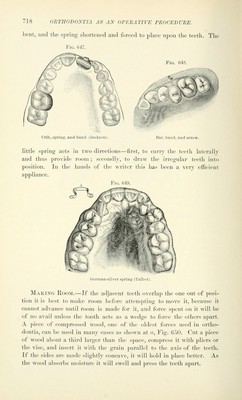
![bent, and tlie spring sliortencd and forced to place ii])on the teeth. The Fig. G47. Fig. 648. Crib, spring, and band (Jackson) Bar, band, and screw. little spring acts in two directions—first, to carry the teeth laterally and thus provide room; secondly, to draw the irregular teeth into position. In the hands of the writer this has been a very efficient appliance. Fig. 649. German-silver spring (Talbot). Making Room.—If the adjacent teeth overlap the one out of posi- tion it is best to make room before attempting to move it, because it cannot advance until room is made for it, and force spent on it will be of no avail unless the tooth acts as a wedge to force the others a]:)art. A piece of compressed wood, one of the oldest forces used in ortho- dontia, can be used in many cases as shown at a, Fig. 650. Cut a piece of wood about a third larger than the space, compress it with pliers or the vise, and insert it with the grain parallel to the axis of the teeth. If the sides are made slightly concave, it will hold in place better. As the w^ood absorbs moisture it will swell and press the teeth apart.](https://iiif.wellcomecollection.org/image/b21216629_0720.jp2/full/800%2C/0/default.jpg)