The American text-book of operative dentistry / In contributions of eminent authorities. Ed. by Edward C. Kirk.
- Edward Cameron Kirk
- Date:
- 1900
Licence: Public Domain Mark
Credit: The American text-book of operative dentistry / In contributions of eminent authorities. Ed. by Edward C. Kirk. Source: Wellcome Collection.
Provider: This material has been provided by the Augustus C. Long Health Sciences Library at Columbia University and Columbia University Libraries/Information Services, through the Medical Heritage Library. The original may be consulted at the the Augustus C. Long Health Sciences Library at Columbia University and Columbia University.
733/864 (page 731)
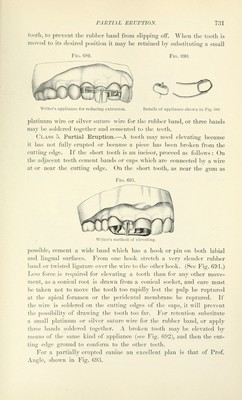
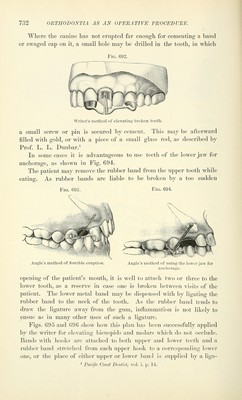
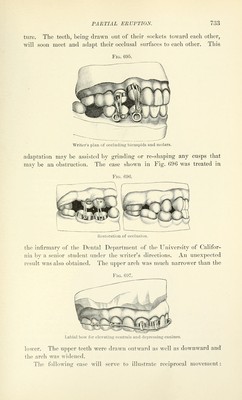
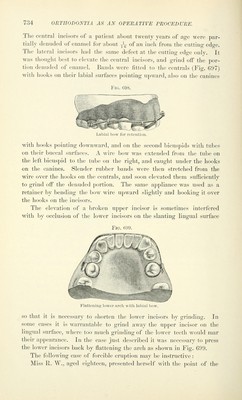
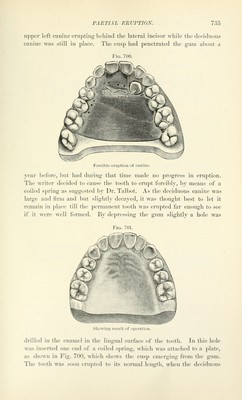
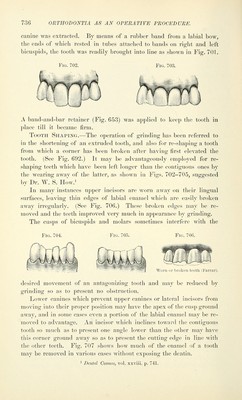
![tooth, to prevent the rubl)er band from slipping off. When the tooth is moved to its desired position it may be retained by substituting a small Fig. 689. Fig. 690. Writer's appliance for reducing extrusion. Details of appliance shown in Fig. 689. platinum wire or silver suture ^\•ire for the rubber band, or three bands may be soldered together and cemented to the teeth. Class 5. Partial Eruption.—A tooth may need elevating because it has not fully erupted or because a piece has been broken from the cutting edge. If the short tooth is an incisor, proceed as follows : On the adjacent teeth cement bands or caps which are connected bv a wire at or near the cutting edge. On the short tooth, as near the gum as Fig. 691. Writer's method of elevating. possible, cement a wide band which has a hook or pin on both labial and lingual surfaces. From one hook stretch a very slender rubber band or tM'isted ligature over the wire to the other hook. (See Fig. 691.) Less force is required for elevating a tooth than for any other move- ment, as a conical root is drawn from a conical socket, and care must be taken not to move the tooth too rapidly lest the pulp be ruptured at the apical foramen or the peridental membrane be ruptured. If the wire is soldered on the cutting edges of the caps, it will prevent the possibility of drawing the tooth too far. For retention substitute a small platinum or silver suture wire for the rubber band, or apply three bands soldered together. A broken tooth may be elevated by means of the same kind of ap])liance (see Fig. 692), and then the cut- ting edge ground to conform to the other teeth. For a partially erupted canine an excellent plan is that of Prof. Angle, shown in Fig. 693.](https://iiif.wellcomecollection.org/image/b21216629_0733.jp2/full/800%2C/0/default.jpg)