The American text-book of operative dentistry / In contributions of eminent authorities. Ed. by Edward C. Kirk.
- Edward Cameron Kirk
- Date:
- 1900
Licence: Public Domain Mark
Credit: The American text-book of operative dentistry / In contributions of eminent authorities. Ed. by Edward C. Kirk. Source: Wellcome Collection.
Provider: This material has been provided by the Augustus C. Long Health Sciences Library at Columbia University and Columbia University Libraries/Information Services, through the Medical Heritage Library. The original may be consulted at the the Augustus C. Long Health Sciences Library at Columbia University and Columbia University.
736/864 (page 734)
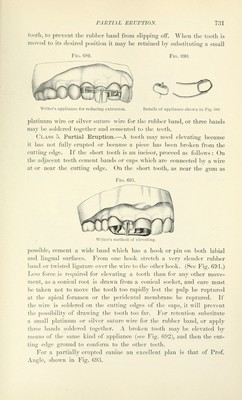
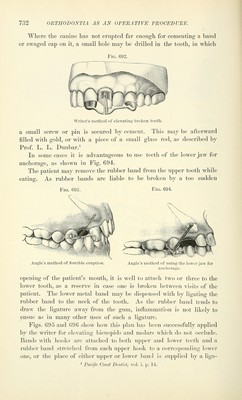
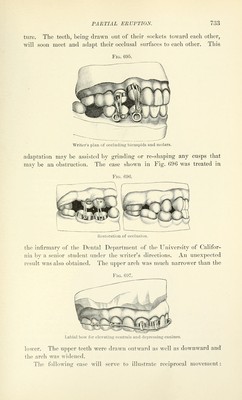
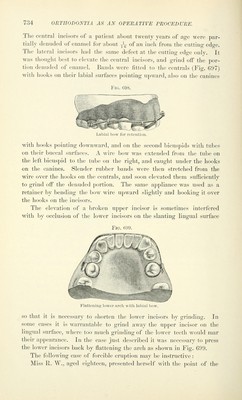
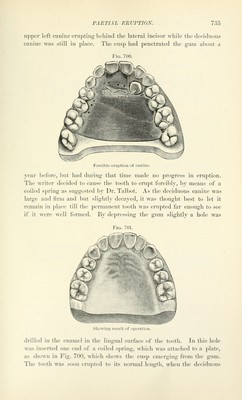
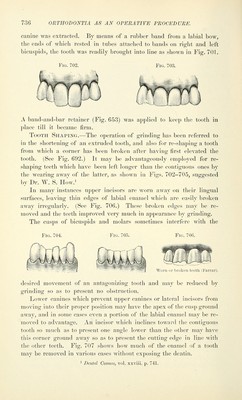
![The central iiioisor.s of a patient about twenty years of age were par- tially denuded of enamel for about Jg- of an inch from the cutting edge. The lateral incisors had the same defect at the cutting edge only. It was thought best to elevate the central incisors, and grind off the por- tion denuded of enamel. Bands were fitted to the centrals (Fig. 697) >vith hooks on their labial surfaces pointing upward, also on the canines Fk;. 698. Labial bow for ix'tention. with hooks pointing downward, and on the second bicuspids with tubes on their buccal surfaces. A wire bow was extended from the tube on the left bicuspid to the tube on the right, and caught under the hooks on the canines. Slender rubber bands were then stretched from the wire over the hooks on the centrals, and soon elevated them sufficiently to grind off the denuded portion. The same appliance was used as a retainer by bending the bow wire upward slightly and hooking it over the hooks on the incisors. The elevation of a l^roken upper incisor is sometimes interfered with by occlusion of the lower incisors on the slanting lingual surface Fig. 699. Flattening lower arch with labial bow. SO that it is necessarv to shorten the lower incisors bv orrindincr. In some cases it is warrantable to grind away the upper incisor on the lingual surface, where too much grinding of the lower teeth would mar their appearance. In the case just described it was necessary to press the lower incisors back by flattening the arch as shown in Fig. 699. The following case of forcible eru])tion may be instructive: Miss R. W., aged eighteen, presented herself with the point of the](https://iiif.wellcomecollection.org/image/b21216629_0736.jp2/full/800%2C/0/default.jpg)