The American text-book of operative dentistry / In contributions of eminent authorities. Ed. by Edward C. Kirk.
- Edward Cameron Kirk
- Date:
- 1900
Licence: Public Domain Mark
Credit: The American text-book of operative dentistry / In contributions of eminent authorities. Ed. by Edward C. Kirk. Source: Wellcome Collection.
Provider: This material has been provided by the Augustus C. Long Health Sciences Library at Columbia University and Columbia University Libraries/Information Services, through the Medical Heritage Library. The original may be consulted at the the Augustus C. Long Health Sciences Library at Columbia University and Columbia University.
752/864 (page 750)
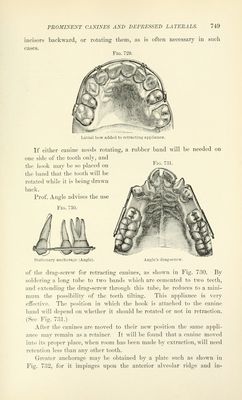
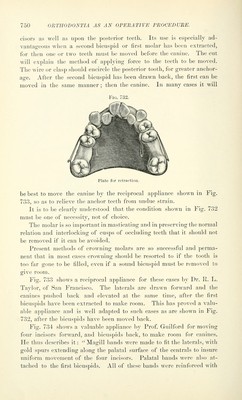
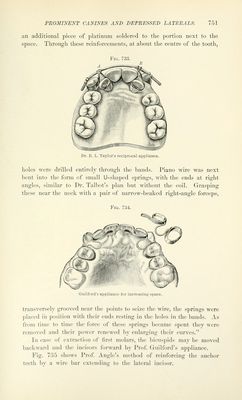
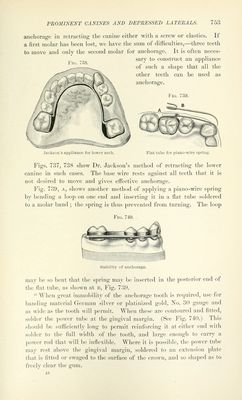
![cisors as well us u]k)1i the posterior teeth. Its use is especially ad- vautaii-eoiis when a seeoiul bicuspid or first molar has been extracted, for then one or two teeth must be moved before the canine. The cut will e.\j)lain the method of applyin*^ force to the teeth U) be moved. The wire or clasp should encircle the j)ostcrior tooth, for greater anchor- age. After the second bicuspid has been drawn back, the first can be moved in the same manner; then the canine. In many cases it will Fig. 732. Plate for retraction. be best to move the canine by the reciprocal appliance shown in Fig. 733, so as to relieve the anchor teeth from undue strain. It is to be clearly understood that the condition shown in Fig. 732 must be one of necessity, not of choice. The molar is so important in masticating and in preserving the normal relation and interlocking of cusps of occluding teeth that it should not be removed if it can be avoided. Present methods of crowning molars are so successful and perma- nent that in most cases crowning should be resorted to if the tooth is too far gone to be filled, even if a sound bicuspid must be removed to give room. Fig. 733 shows a reciprocal appliance for these cases by Dr. R. L. Taylor, of San Francisco. The laterals are drawn forward and the canines pushed back and elevated at the same time, after the first bicuspids have been extracted to make room. This has proved a valu- able appliance and is well adapted to such cases as are shown in Fig. 732, after the bicuspids have been moved back. Fig. 734 shows a valuable appliance by Prof. Guilford for moving four incisors forward, and bicuspids back, to make room for canines. He thus describes it: *' Magill bands were made to fit the laterals, with gold spurs extending along the palatal surface of the centrals to insure uniform movement of the four incisors. Palatal bands were also at- tached to the first bicuspids. All of these bands were reinforced with](https://iiif.wellcomecollection.org/image/b21216629_0752.jp2/full/800%2C/0/default.jpg)