The American text-book of operative dentistry / In contributions of eminent authorities. Ed. by Edward C. Kirk.
- Edward Cameron Kirk
- Date:
- 1900
Licence: Public Domain Mark
Credit: The American text-book of operative dentistry / In contributions of eminent authorities. Ed. by Edward C. Kirk. Source: Wellcome Collection.
Provider: This material has been provided by the Augustus C. Long Health Sciences Library at Columbia University and Columbia University Libraries/Information Services, through the Medical Heritage Library. The original may be consulted at the the Augustus C. Long Health Sciences Library at Columbia University and Columbia University.
772/864 (page 770)
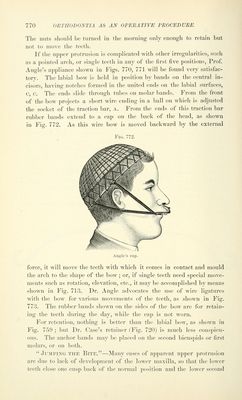
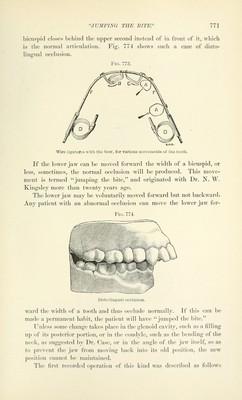
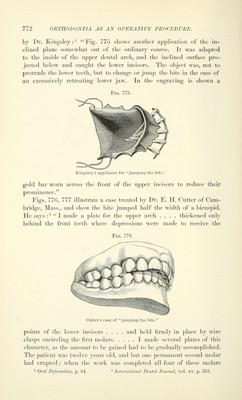
![The nuts slioiiltl be turned in the morning only enough to retain but not to move the teeth. It'the u|)i)er ])rotrusion is complicated with other irregularities, such as a pointed arch, or single teeth in any of the lirst five positions, Prof. Angle's ai)pliance shown in Figs. 770, 771 will be found very satisfac- tory. The labial bow is held in ])()sition by bands on the central in- cisors, having notches formed in the united ends on the labial surfaces, c, c. The ends slide through tubes on molar bands. From the front of the bow^ projects a short wire ending in a ball on which is adjusted the socket of the traction bar, a. From the ends of this traction bar rubber bands extend to a cap on the back of the head, as shown in Fig. 772. As this wire bow is moved backward by the external Fi(i. 772. Angle's cap. force, it will move the teeth with which it comes in contact and mould the arch to the shape of the bow ; or, if single teeth need special move- ments such as rotation, elevation, etc., it may be accomplished by means shown in Fig. 713. Dr. Angle advocates the use of wire ligatures with the bow for various movements of the teeth, as shown in Fig. 773. The rubber bands shown on the sides of the bow are for retain- ing the teeth during the day, while the cap is not Avorn. For retention, nothing is better than the labial bow, as shown in Fig. 759 ; but Dr. Case's retainer (Fig. 720) is much less conspicu- ous. The anchor bands may be placed on the second bicuspids or first molars, or on both. Jumping the Bite.—Many cases of apparent upper protrusion are due to lack of development of the lower maxilla, so that the lower teeth close one cusp back of the normal position and the lower second](https://iiif.wellcomecollection.org/image/b21216629_0772.jp2/full/800%2C/0/default.jpg)