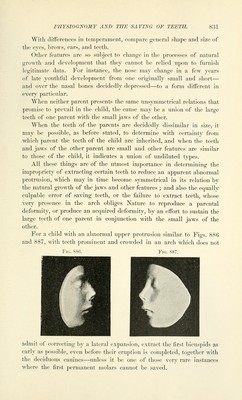
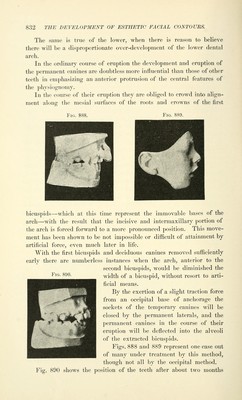
The American text-book of operative dentistry / In contributions of eminent authorities. Ed. by Edward C. Kirk.
- Edward Cameron Kirk
- Date:
- 1900
Licence: Public Domain Mark
Credit: The American text-book of operative dentistry / In contributions of eminent authorities. Ed. by Edward C. Kirk. Source: Wellcome Collection.
Provider: This material has been provided by the Augustus C. Long Health Sciences Library at Columbia University and Columbia University Libraries/Information Services, through the Medical Heritage Library. The original may be consulted at the the Augustus C. Long Health Sciences Library at Columbia University and Columbia University.
830/864 (page 828)
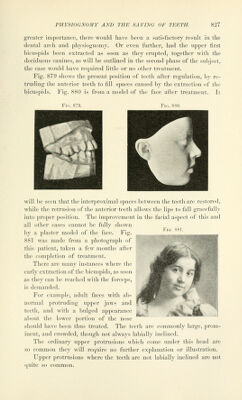
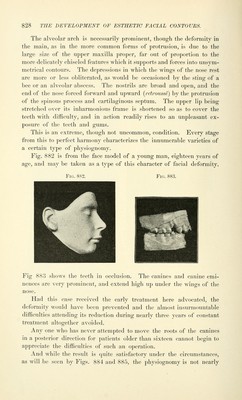
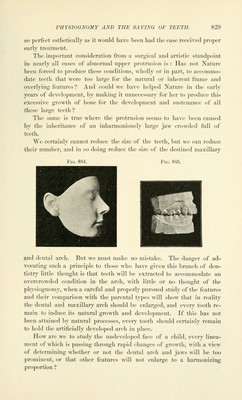
![The alveolar arch is necessarily prominent, though the deformity in the main, as in the more common iorms of ])rotrusion, is due to the large size of the upper maxilla proper, far out of proportion to the more delicately chiseled features which it sup})orts and forces into unsym- metrical contours. The depressions in which the wings of the nose rest are more or less obliterated, as would be occasioned by the sting of a bee or an alveolar abscess. The nostrils are broad and open, and the end of the nose forced forward and upward (retrousse) by the protrusion of the spinous process and cartilaginous septum. The upper lip being- stretched over its inharmonious frame is shortened so as to cover the teeth with difficulty, and in action readily rises to an unpleasant ex- posure of the teeth and gums. This is an extreme, though not uncommon, condition. Every stage from this to perfect harmony characterizes the innumerable varieties of a certain type of physiognomy. Fig. 882 is from the face model of a young man, eighteen years of age, and may be taken as a type of this character of facial deformity. Fig. 882. Fig. 883. Fig 883 shows the teeth in occlusion. The canines and canine emi- nences are very prominent, and extend high up under the wings of the nose. Had this case received the early treatment here advocated, the deformity would have been prevented and the almost insurmountable difficulties attending its reduction during nearly three years of constant treatment altogether avoided. Any one who has never attempted to move the roots of the canines in a posterior direction for patients older than sixteen cannot begin to appreciate the difficulties of such an operation. And while the result is quite satisfactory under the circumstances, as will be seen by Figs. 884 and 885, the physiognomy is not nearly](https://iiif.wellcomecollection.org/image/b21216629_0830.jp2/full/800%2C/0/default.jpg)