The American text-book of operative dentistry / In contributions of eminent authorities. Ed. by Edward C. Kirk.
- Edward Cameron Kirk
- Date:
- 1900
Licence: Public Domain Mark
Credit: The American text-book of operative dentistry / In contributions of eminent authorities. Ed. by Edward C. Kirk. Source: Wellcome Collection.
Provider: This material has been provided by the Augustus C. Long Health Sciences Library at Columbia University and Columbia University Libraries/Information Services, through the Medical Heritage Library. The original may be consulted at the the Augustus C. Long Health Sciences Library at Columbia University and Columbia University.
836/864 (page 834)
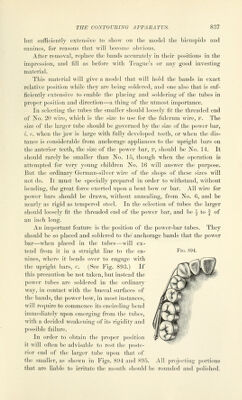
![the direction iiulicated l)y the arrow, theii will the <)i)p().sing wall, i;, of the alveolar socket near its margin receive nearly all of the direct force ; and in j)roportion to its resistance will there be a tendency to move the root in the o])j)osite direction. This will also hold good even if the force be applied at a. Fig. 892, or as I'ar upon the root as may be per- mitted by attaching a rigid npright bar, c, to the anterior surface of the B-^ crown ; the only difference being that the direct force is distributed over a greater area. But if, as in Fig. 893, to the lower end of c a traction wire or bar, f, is attached and if the mechanical principles of the machine be further enforced by uniting its posterior attachment to the anchorage of the power bar, p, the anchorage force will be materially neutralized and an independent static fulcrum at d created. The appa- ratus now will distribute its force over the entire root, and give com- plete direction and control of whatever power is put into it. The Fig. 893. entire tooth may be carried forward bodily or either end may be made to move the more rapidly. The force thus directed to the ends of the roots will have an increased tendency to move the more or less yielding bone in which they are imbedded. For practical illustrations of what has been accomplished by an apparatus of this kind see cases described in sections I., IV., and V. of this chapter. The contouring apparatus is made entirely of German silver, with the exception of the nuts, which are of nickel. German silver is pre- ferred, not because it is cheaper than gold and platinum, but because it](https://iiif.wellcomecollection.org/image/b21216629_0836.jp2/full/800%2C/0/default.jpg)