The American text-book of operative dentistry / In contributions of eminent authorities. Ed. by Edward C. Kirk.
- Edward Cameron Kirk
- Date:
- 1900
Licence: Public Domain Mark
Credit: The American text-book of operative dentistry / In contributions of eminent authorities. Ed. by Edward C. Kirk. Source: Wellcome Collection.
Provider: This material has been provided by the Augustus C. Long Health Sciences Library at Columbia University and Columbia University Libraries/Information Services, through the Medical Heritage Library. The original may be consulted at the the Augustus C. Long Health Sciences Library at Columbia University and Columbia University.
96/864 (page 94)
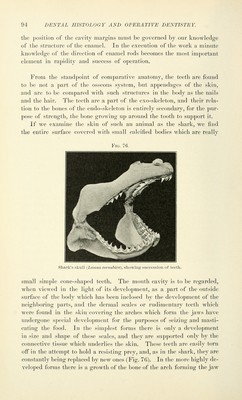
![the position of the cavity margins must be governed by our knowledge of the structure of the enamel. In the execution of the work a minute knowledge of the direction of enamel rods l)ecomes the most imjiortant element in rapidity and success of operation. From the standpoint of comparative anatomy, the teetli are found to be not a part of the osseous system, but appendages of the skin, and are to be compared with such structures in the body as the nails and the hair. The teeth are a part of the exo-skeleton, and their rela- tion to the bones of the endo-skeleton is entirely secondary, for the pur- pose of strength, the bone growing up around the tooth to support it. If we examine the skin of such an animal as the shark, we find the entire surface covered with small calcified bodies Avhich are really Fuj. 76, Shark's skull [Lmnna cuniubira), showiiiK saeeossiuu of teeth. small simple cone-shaped teeth. The mouth cavity is to be regarded, when viewed in the light of its development, as a part of the outside surface of the body which has been inclosed by the development of the neighboring parts, and the dermal scales or rudimentary teeth which were found in the skin covering the arches which form the jaws have undergone special development for the purposes of seizing and masti- cating the food. In the sim])lest forms there is only a development in size and shape of these scales, and they are supported only by the connective tissue which underlies the skin. These teeth are easily torn off in the attempt to hold a resisting prey, and, as in the shark, they are constantly being replaced by new ones (Fig. 76). In the more highly de- veloped forms there is a growth of the bone of the arch forming the jaw](https://iiif.wellcomecollection.org/image/b21216629_0096.jp2/full/800%2C/0/default.jpg)