The diseases of personality / by Th. Ribot ; tr. from the French by J. Fitzgerald.
- Théodule-Armand Ribot
- Date:
- 1887
Licence: Public Domain Mark
Credit: The diseases of personality / by Th. Ribot ; tr. from the French by J. Fitzgerald. Source: Wellcome Collection.
Provider: This material has been provided by the Francis A. Countway Library of Medicine, through the Medical Heritage Library. The original may be consulted at the Francis A. Countway Library of Medicine, Harvard Medical School.
21/68 page 15
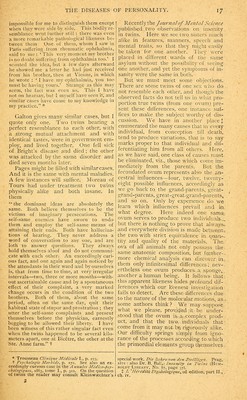
![succumbed, not to her own ailment but to those of her sister. The twins expired at the same instant. The Siamese Twins, Chang and Eng, born in 1811 in the kingdom of Siam, were connected from the navel to the xiphoid appendix. I. G. de Saint-Hilaire, after describing their outward habitus, adds that, The two brothers, even in their other functions [besides respiration and the ar- terial pulsation] exhibit a concordance that is remarkable, though not absolutely con- stant as has been artirmed, and as Chang and Eng themselves have been wont tu assure those who went no farther than to put to the twins a few vague questions. No doubt there is nothing more curious than the contrast of almost complete physical du- ality with absolute moral unity—but there is nothing so opposed to sound theory. I have carefully nrade every observation, and gathered all the information that could help me to determine the truth of what has been so often asserted, and I have found that, in this conflict between the ill-understood prin- ciples of teratology and the many physio- logical doctrines that have been based on the unity of the Siamese brothers, the facts, as was to have been expected, are entirely in favor of the former. These twin brothers, cast in two nearly identical moulds, of neces- sity subject throughout their lives to the in- fluence of the same physical and moral en- vironment, having a similar organization and receiving the same education, present the spectacle of two creatures whose functions, actions, words, whose very thoughts are nearly always concordant and parallel Their joys, their sorrows, are in common : the same desires arise at the same instant in these twin souls, the sentence that is begun by one is often completed by the other. Nevertheless these concordances prove parity, not unity. Twins in the normal state often exhibit analogous concordances, and no doubt they would present agreements quite as remarkable if they had during their whole lives seen the same objects, experi- enced the same sensations, shared in the same pleasures, undergone the same suffer- ings. * And I may add that as the Siamese twins grew older, their differences of character became more and more pro- nounced; one of the latest observers de- scribes one of the brothers as morose and taciturn, the other as sprightly and cheerful. Inasmuch as the present work is not intended to be a Psychology qf Double Monsters, which find a place in this I * Hist, des Anomalies^ tome 3,.p. 90, et seq. treatise only as instances of deviation of personal identity, I shall simply men- tion the recent case of Millie and Chris- tine, in whom the sensibility of the lower members is in common ; consequently the two spinal cords must form a regular chiasma at the point of union. The law, both civil and ecclesiastical, takes cognizance of this phenomenon of double monsters, as involving questions of civil status, marriage, right of succes- sion, baptism, etc.; it has unhesitatingly recognized two persons wherever such monsters present two distinct heads. And justly so, though in practice embar- rassing questions may arise. The head being in man the true seat of personality and the place where the synthesis of per- sonality takes place—though this cloes not appear so certain as we descend the animal scale—it fairly stands for the in- dividual. But when the question is dis- cussed scientifically it is impossible, in the case of double monsters, to consider each individual as complete. I will not weary the reader with un- necessary comments, since the facts speak for themselves. Whoever exam- ines attentively what has been said, will see that even in cases where the person- alities are most distinct, there is such a blending of organs and functions that each of the twins can be himself only by being more or iess the other and by hav- ing consciousness of that other. The Me therefore is not an entity that acts where and how it pleases, controlling the organs in its own way, limiting its own province at will. On the contrary it is so truly a resultant that its domain is strictly determined by its anatomical connections with the brain, and that it represents, now a complete body less some undivided part, again a part of a body and, in the case of parasital mon- sters, so small a part that it cannot sub- sist, and becomes aborted. To prove once more and in another way that the organism is the principle of individuation; and that it is such without any restriction, directly through the or- ganic sensations, indirectly through the affective and intellective states of which we shall speak later ; let us see what takes place in twins. Psychology has hardly concerned itself about twins any more than about double monsters, but biologists have brought to light some cu- rious facts. First it is to be remarked that double](https://iiif.wellcomecollection.org/image/b21074409_0021.jp2/full/800%2C/0/default.jpg)