The diseases of personality / by Th. Ribot ; tr. from the French by J. Fitzgerald.
- Théodule-Armand Ribot
- Date:
- 1887
Licence: Public Domain Mark
Credit: The diseases of personality / by Th. Ribot ; tr. from the French by J. Fitzgerald. Source: Wellcome Collection.
Provider: This material has been provided by the Francis A. Countway Library of Medicine, through the Medical Heritage Library. The original may be consulted at the Francis A. Countway Library of Medicine, Harvard Medical School.
23/68 page 17
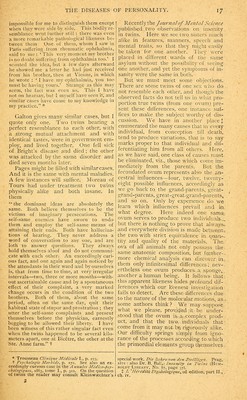
![impossible for me to distinguish them except when they were side by side. This bodily re- semblance went further still : there was even a more remarkable pathological likeness be- tween them One of them, whom I saw in Paris suffering from rheumatic ophthalmia, said to me : ' This very moment my brother is no doubt suffering from ophthalmia too.' I scouted the idea, but a few days after^yard he showed me a letter he had just received from his brother, then at Vienne, in which he wrote : ' I have my ophthalmia, you too must be having yours.' Strange as this may seem, the fact was even so. This I have not on hearsay, but I myself have seen it, and similar cases have come to my knowledge in my practice. * Galton gives many similar cases, but I quote only one. Two twins bearing a perfect resemblance to each other, with a strong mutual attachment and with identical tastes, were in government em- ploy, and lived together. One fell sick of Bright's disease and died ; the other was attacked by the same disorder and died seven months later. Pages might be filled with similar cases. And it is the same with mental maladies. A few instances will suffice. Moreau of Tours had under treatment two twins physically alike and both insane. In them the dominant ideas are absolutely the same. Both believe themselves to be the victims of imaginary persecutions. The self-same enemies have sworn to undo them and employ the self-same means of attaining their ends. Both have hallucina- tions of hearing. They never address a word of conversation to any one, and are loth to answer questions. They always hold themselves aloof and do not communi- cate with each other. An exceedingly curi- ous fact, and one again and again noticed by the attendants in their ward and by ourselves is, that from time to time, at very irregular intervals—two, three or more months—with- out ascertainable cause and by a spontaneous effect of their complaint, a very marked change occurs in the condition of the two brothers. Both of them, about the same ]5eriod, often on the same day, quit their habitual state of stupor and j^rostration ; they utter the self-same complaints and present themselves before the physician, earnestly begging to be allowed their liberty. I have been witness of this rather singular fact even when the twins happened to be several kilo- meters apart, one at Bicetre, the other at the Ste. Anne farm. t * Trousseau Clinigue Medicale I., p. 253. t Psychologie Morbide, p. 172. See also an ex- ceedingly curious case in the Annales Medico-psy- c/toiogifjues, 1863, tome I., p. 312. On the question of twins the reader may consult Kleinweechter's Recently \\\& Journal of Mental Science publish-edjwo observ^ations on insanity in twins. Here we see two sisters much alike in features, manners, speech and mental traits, so that they might easily be taken for one another. They were placed in different wards of the same asylum without the possibility of seeing one another, and yet the symptoms of in- sanity were the same in both. But we must meet some objections. There are some twins of one sex who do not resemble each other, and though the observed facts do not tell us in what pro- portion true twins (from one ovum) pre- sent these differences, one instance suf- fices to make the subject worthy of dis- cussion. We have in another place \ enumerated the many causes that in evesy individual, from conception till death, tend to produce variations, that is to say marks proper to that individual and dif- ferentiating him from all others. Here, as we have said, one class of causes must be eliminated, viz., those which come im- mediately from the parents. But the fecundated ovum represents also the an- cestral influences—four, twelve, twenty- eight possible influences, accordingly as we go back to, the grand-parents, great- grand-parents, great-great-grand-parentSj and so on. Only by experience do we learn which influences prevail and jn.,, what degree. Here indeed one sacBQi: ovum serves to produce two individttals.;^ but there is nothing to prove that alwayss and everywhere division is made betjcvie^ens the two with strict equivalence in qc\an-- tity and quality of the materials,. The,- ova of all animals not only posSiSss the ■ same anatomic composition, but fclrt-her-- more chemical analysis can discoverrin. 1 them only infinitesimal differences,-:nev-- ertheless one ovum produces-.a, sponge,., another a human being. It fellows that 1. this apparent likeness hides,profound dif- . ferences which our keenest: investigation ■ fails to detect. Are these-i,ifferences due to the nature of the molecalar motions, as.-, some authors think .> We may suppose what we please, provii|ed:it, be under-, stood that the ovum i^^a-iComplex prod- uct, and that the twoniridiyiduals that, come from it may no,t, b^ ri,gorQusly alike. . Our difficulty springs siqiply. from igno-- ranee of the processes according to \vhich the primordial elesaents group themselves , special work. Die Lekrevon den ZwiUigen. Frag-, 1871 : also Dr. B, Ball,] Insanity in 7\vins (Hum- boldt Library, No. 87, page 37). X L 'Hei-editi SsytJiolo^qug^zCi. edition, part II., ch. iv.](https://iiif.wellcomecollection.org/image/b21074409_0023.jp2/full/800%2C/0/default.jpg)