The diseases of personality / by Th. Ribot ; tr. from the French by J. Fitzgerald.
- Théodule-Armand Ribot
- Date:
- 1887
Licence: Public Domain Mark
Credit: The diseases of personality / by Th. Ribot ; tr. from the French by J. Fitzgerald. Source: Wellcome Collection.
Provider: This material has been provided by the Francis A. Countway Library of Medicine, through the Medical Heritage Library. The original may be consulted at the Francis A. Countway Library of Medicine, Harvard Medical School.
34/68 page 28
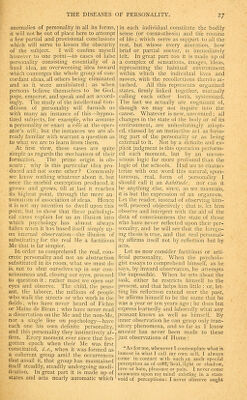
![save perception. ... If any one, after seri- ous reflection and without prejudices, thinks he has any other idea of himselt, 1 coniess tluit 1 can reason no longer with hnn. The best I can say lor hnn is tnat perhaps he is right no less man 1, and lliat on this point our na- tures are essentially dilferent. It is possible tnai he may perceive something simple and permanent wiucli he calls hinibelf, but as for me 1 am quite sure i possess no such prin- ciple. iiume, W orks, vol. i,p. 321. Since Hume's day some one has said : 'inioLign tne sense ot eiiort and of resist- ance we reel that we cause [par ieffort ct la resistance, nous nous sentons cause]. True ; and pretty nearly ail schools agree that in tins way the Aie distinguishes it- self from the non-Ale : but the sense of effort nevertheless is still simply a state of consciousness—the sense of the mus- cular energy spent to produce a given act. To seek to grasp by analysis a syn- thetic whole as personality is, or by an in- tuition of consciousness lasting at most a few seconds to seize a complex like the Me, were to attempt the solution of a problem whose data are mutually con- tradictory. The psychologists have gone to work differently. They have con- sidered states of consciousness as ac- cessories, and the tie that connects them as the essential thing: and it is this mys- terious underlying somethi7ig that, under the name of unity, identity, or continuity, becomes the true Me. Nevertheless plainly we have here only an abstraction, or more precisely a schema. For the real personality has been substituted the idea of personality—a very different thing. This idea of personality is like all general terms formed in the same Vv'ay, as sensi- bility, will, etc.; but it is no more like the real personality than the plan of a city is like the city itself. And as in the cases of aberration of personality that have led to the present remarks, one idea has taken the place of a complex, forming an imaginary and a diminished personality, so bv the psychologist the schema of person- ality is substituted for the concrete per- sonality, and it is upon this beggarly framework that he rests all his reasoning, inductions, deductions and dogmatizings. Of course this comparison is made on the condition of mutatis mutandis and with many restrictions, which the reader will find out for himself. In short, for one to reflect on his Me is to take an artificial position which changes its nature—to substitute an ab- stract representation for a reality. The true Me is that which feels, thinks, acts without exhibiting itself, so to speak, to itself upon a stage. For the Me is in' its nature and by its definition a subject; and to become an object it must undergo a reduction, an adaptation to the mind's optical conditions, and that transforms it, mutilates it. Till now we have considered the ques- tion only on its negative side. To what positive hypothesis as to the nature of personahty are we led by the observation of morbid cases } First let us lay aside the hypothesis of a transcendental entity —an hypothesis that cannot be recon- ciled with pathology, and which explains nothing. Let us put aside also the hypothesis which makes of the Me a bundle of sen- sations or of states of consciousness, as many have held it to be, following Hume. So to think is to take appearances for reality, a group of signs for a thing, or more exactly, to take effects for their cause. Besides, if, as we hold, conscious- ness is only an indicative phenomenon, it cannot be a constitutive state. We have to penetrate deeper, to that co7isensus of the organism of which the conscious Me is but the psychological ex- pression. Has this hypothesis any firmer ground than the other two ? Both ob- jectively and subjectively considered, the characteristic trait of personality is that, continuity in time, that permanence which is called identity. This has been denied of the organism, on grounds so well knovi'n that there is no need to state them : but it is strange that those who refuse to concede continuity, identity, to the organism should fail to see that all the arguments for a transcendental prin- ciple hold good also for the organism, and that all the arguments that can be brought against the latter have the same force against the former. That every higher organism is one in its complexity IS an observation at least as old as the Hippocratic writings , and since Bichat's time no one attributes this unity to a mysterious vital principle ; certain writers however make a great noise about the constant molecular renovation which con- stitutes life, and ask. Where is the iden- tity .'' But as a fact every one believes in this identity of the organism. Identity is not immobility. If, as some savants hold, life has its seat not so much in the chemical substance of the protoplasm, as in the motions of the particles, then it is a combination of motions, or a form of motion, and this constant](https://iiif.wellcomecollection.org/image/b21074409_0034.jp2/full/800%2C/0/default.jpg)