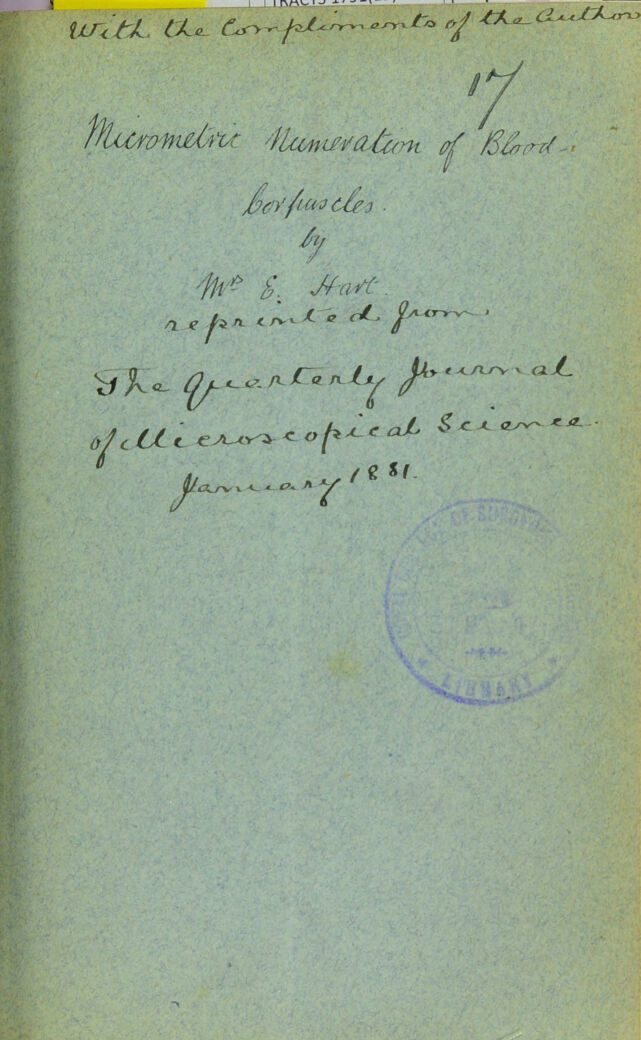
On the micrometric numeration of the blood-corpuscles and the estimation of their haemoglobin / by Mrs. Ernest Hart.
- Hart, Mrs Ernest, 1848-1931.
- Date:
- [1881]
Licence: Public Domain Mark
Credit: On the micrometric numeration of the blood-corpuscles and the estimation of their haemoglobin / by Mrs. Ernest Hart. Source: Wellcome Collection.
Provider: This material has been provided by The Royal College of Surgeons of England. The original may be consulted at The Royal College of Surgeons of England.
4/17
![VOL. XXI.—NEW SEE.] On the Micrometric Numeration of the Blood-cor- puscles and the Estimation of their FLemoglorin. By Mrs. Ernest Hart. The micrometric numeration of the blood-corpuscles and the estimation of hemoglobin are operations which, though of comparatively recent introduction, have rapidly passed out of the sphere of laboratory experiment into practical use as exact methods of physiological and clinical investiga- tion. Those who have worked at this subject cannot, how- ever, have proceeded far without discovering that the methods and instruments hitherto in use are inconveniently imperfect and vitiated by numerous sources of error. Some recent improvements by M. Malassez, assistant in the La- boratory of Histology in the College de France, appear to me to have done much to remove these disadvantages. Before proceeding, however, to describe the new Corpuscle- Counter which M. Malassez has just introduced, it may be well to say a few words on the methods and instruments usually employed for the numeration of the corpuscles. The three which have been hitherto in general use are those known as the instruments of Malassez, Hayem, and Gowers. In the method first invented by Malassez (the Compte- Globules Capillaire) 100 parts of a 5 per cent, solution of sulphate of soda are mixed in a special instrument called the Melangeur Potain (Fig. 1) with one part of blood. This solution is then drawn into an extremely fine capillary tube. The calibre of this tube is known ; hence the volume of the fluid which the tube contains in a given length, say in 500, 400, or 300 micro-millimeters is also known.1 This volume is some frac- V tion of a cubic millimeter. It follows that the volume multi- plied by the denominator of that fraction will equal a cubic millimeter. The multiplier is written on a glass plate, on which the capillary tube is mounted. Before using the instru- ment the eye-piece of the microscope must be exchanged for an eye-piece containing a micrometer divided into a number of square millimeters. Then by means of a stage micro- meter, the microscope must be graduated, so that ten of the square millimeters of the eye-piece correspond exactly to the arbitrary length (500/*, 400^, or 300/i) fixed upon. A mark being then put on the tube of the microscope, this magnifying power—the lens being always the same—can be easily found again. The process and calculation are then](https://iiif.wellcomecollection.org/image/b22450816_0005.jp2/full/800%2C/0/default.jpg)