Veterinary medical science and human health : veterinary activities of agencies of the United States Government in relationship to functions performed by State and local governments, private groups, and intergovernmental organizations / Prepared for the Committee on Government Operations, U.S. Senate and its Subcommittee on Reorganization and International Organizations (pursuant to S. Res. 347, 85th Congress, and S. Res. 42 and 255, 86th Congress).
- United States. Congress. Senate. Committee on Government Operations
- Date:
- 1961
Licence: Public Domain Mark
Credit: Veterinary medical science and human health : veterinary activities of agencies of the United States Government in relationship to functions performed by State and local governments, private groups, and intergovernmental organizations / Prepared for the Committee on Government Operations, U.S. Senate and its Subcommittee on Reorganization and International Organizations (pursuant to S. Res. 347, 85th Congress, and S. Res. 42 and 255, 86th Congress). Source: Wellcome Collection.
210/272 page 188
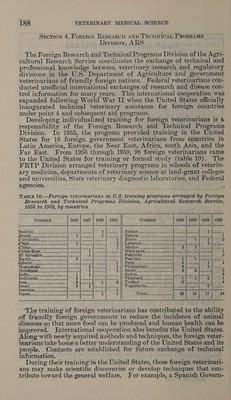
![’ Srcrion 4. Foreign RESEARCH AND TECHNICAL PROGRAMS Drviston, ARS The Foreign Research and Technical Programs Division of the Agri- cultural Research Service coordinates the exchange of technical and professional knowledge between veterinary research and regulatory divisions in the U.S. Department of Agriculture and government veterinarians of friendly foreign nations. Federal vetermarians con- ducted unofficial international exchanges of research and disease con- trol information for many years. This international cooperation was expanded following World War II when the United States officially inaugurated technical veterinary assistance for foreign countries under point 4 and subsequent aid programs. ? Developing individualized training for foreign veterinarians is a responsibility of the Foreign Research and Technical Programs Division. In 1955, the program provided training in the United States for 16 foreign government veterinarians from countries in Latin America, Europe, the Near East, Africa, south Asia, and the Far East. From 1956 through 1959, 98 foreign veterinarians came to the United States for training or formal study (table 10). The FRTP Division arranged veterinary programs in schools of veterin- ary medicine, departments of veterinary science at land-grant colleges and universities, State veterinary diagnostic laboratories, and Federal agencies. | f TABLE 10.—Foreign veterinarians in U.S. training programs arranged by Foreign Research and Technical Programs Division, Agricultural Research Service, 1956 to 1959, by countries Country 1956 | 1957 | 1958 | 1959 * Country 1956 | 1957°| 1958 | 1959 IBolivigh 4S 2E ek bee Pee Pee Dies ERE Jordan 2.51029. SEAS Ree GATOS) Iw Wravieeses ts | gels ees (| Perera fey ee ae Wen ya 2 see ee ee ee 1 FOES INa G's, elal he xterm ted wrest piiamee Bp Miecoete. I’ |\, Roreat 225° bee eee eee 1 1 2 (les! Hy = FSET i ees se 3 2 \isLebanon ¢42_ 4s 22see Al _ ce eee ee st ee Pe Clim ase ee hat eee | eee 15||) Mexico 22522 See eae 2 2p fei Bes eee. = @osta Ricaaa Lt alse pe ee PO ee Nicaragua? 20) _ eae a PAT Eee 1 fl Salvadors_<.. occ. .|-4- 2 Le See Soars. Pakistan Vo £22 ~ Ss Pe ae ee eee 2 Weg pt se ge ee O) |S aeee| eee ieee ‘Panama seen 1 i] jess heat Girec Ce. Liles. Oe ae Fees |e sae 1 OPrtls ck tye eee eae 7 ects 1 1 Guatemala..-_.-._=2..+_|..-..- pie eee 1D P hlippiBes. aos eee A ele 1 mts a Honduras. 22s oeie 2 2 fesliet 3 be Ft a Lit Spain Sree ret ieee 3 PAYS eee 2 india: toi. Wer ee 8 1 desi Se «oe 2 |Peee = = Sudan... Se oe lie | ee 3 Indonesia____-_- pan Ais Bt Pps aoa Seced | Lp ‘haitlan d+ 232 _ fen Aes 1 1 2 1 Irdnren sen re: eee. See ore 1 3< || Turkey .22n)53-5* Be O tle cet ae 4 Sr ae) 2 cs 8 a a ee 3 Dales eee ee © Wuvoslavias 22) ae a eee eee 6 a. Jam gich sts Fe Soek bes a See ce See ee ee SSS |S lo Japan l4it Lee ee Ma eee 1 6 ‘Totals >) Sees ee 33 14 17 34 ‘The training of foreign veterinarians has contributed to the ability of friendly foreign governments to reduce the incidence of animal <liseases so that more food can be produced and human health can be improved. International cooperation also benefits the United States. Along with newly acquired methods and techniques, the foreign veter- inarians take home a better understanding of the United States and its people. Contacts are established for future exchange of technical information. 3 During their training in the United States, these foreign veterinari- ans may make scientific discoveries or develop techniques that con- tribute toward the general welfare, For example, a Spanish Govern-](https://iiif.wellcomecollection.org/image/b32177458_0210.jp2/full/800%2C/0/default.jpg)