Veterinary medical science and human health : veterinary activities of agencies of the United States Government in relationship to functions performed by State and local governments, private groups, and intergovernmental organizations / Prepared for the Committee on Government Operations, U.S. Senate and its Subcommittee on Reorganization and International Organizations (pursuant to S. Res. 347, 85th Congress, and S. Res. 42 and 255, 86th Congress).
- United States. Congress. Senate. Committee on Government Operations
- Date:
- 1961
Licence: Public Domain Mark
Credit: Veterinary medical science and human health : veterinary activities of agencies of the United States Government in relationship to functions performed by State and local governments, private groups, and intergovernmental organizations / Prepared for the Committee on Government Operations, U.S. Senate and its Subcommittee on Reorganization and International Organizations (pursuant to S. Res. 347, 85th Congress, and S. Res. 42 and 255, 86th Congress). Source: Wellcome Collection.
252/272 page 230
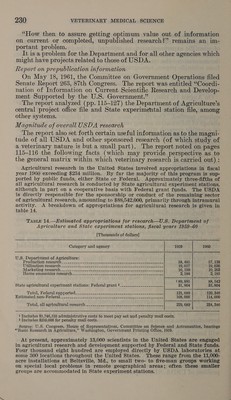
![“How then to assure getting optimum value out of information on current or completed, unpublished research?” remains an im- portant problem. It is a problem for the Department and for all other agencies which might have projects related to those of USDA. Report on prepublication information On May 18, 1961, the Committee on Government Operations filed Senate Report 263, 87th Congress. The report was entitled “Coordi- nation of Information on Current Scientific Research and Develop- ment Supported by the U.S. Government.” The report analyzed (pp. 115-127) the Department of Agriculture’s central project office file and State experimental station file, among other systems. Magnitude of overall U. SDA research The report also set forth certain useful information as to the magni- tude of all USDA and other sponsored research (of which study of a veterinary nature is but a small part). The report noted on pages 115-116 the following facts (which may provide perspective as to the general matrix within which veterinary research is carried out) : Agricultural research in the United States involved appropriations in fiscal year 1960 exceeding $234 million. By far the majority of this program is sup- ported by public funds, either State or Federal. Approximately three-fifths of all agricultural research is conducted by State agricultural experiment stations, although in part on a cooperative basis with Federal grant funds. The USDA is directly responsible for the sponsorship or conduct of the remaining sector of agricultural research, amounting to $88,542,000, primarily through intramural activity. A breakdown of appropriations for agricultural research is given in table 14. TABLE 14.—EHstimated appropriations for research—U.S. Department of Agriculture and State experiment stations, fiscal years 1959-60 [Thousands of dollars] Category and agency 1959 1960 U.S. Department of Agriculture: Production. reSearGh 222.23 = oe de ee ee ee 58, 485 57, 128 Utilization research Lil feiss 2. ess Sid et a ae 19, 017 19, 026 Marketing tesedrch.. 00) 4.3.0 ee oo bee ee eee 10, 199 10, 203 ‘Home’ economics research fo ase fe eee fe eee 2, 184 2, 185 1 89, 885 88, 542 State agricultural experiment stations: Federal grant ?_.......___--..._---_-- 31, 804 31, 804 Total, Federal supported. 22.222 <2 Seas eee aa 121, 689 120, 346 Estimated non-Fedeéraltvsd2. 3 ee ee ee eee 108, 000 114, 000 Total; all. asricuitural research 2-230 -- oo ae see ee ae ee eee 229, 689 234, 346 1 Includes $5,746,510 administrative costs to meet pay act and penalty mail costs. 2 Includes $250,000 for penalty mail costs. Source: U.S. Congress, House of Representatives, Committee on Science and Astronautics, hearings “Basic Research in Agriculture,’’ Washington, Government Printing Office, 1959. At present, approximately 13,000 scientists in the United States are engaged in agricultural research and development supported by Federal and State funds. Four thousand eight hundred are employed directly by USDA laboratories at some 300 locations throughout the United States. These range from the 11,000- acre installations at Beltsville, Md., to small two- to five-man groups working on special local problems in remote geographical areas; often these smaller groups are accommodated in State experiment stations.](https://iiif.wellcomecollection.org/image/b32177458_0252.jp2/full/800%2C/0/default.jpg)