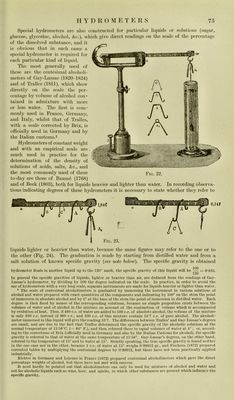
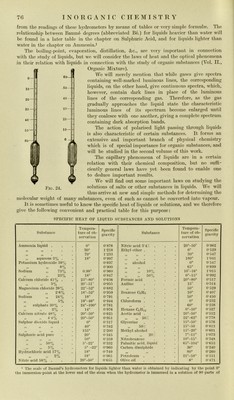
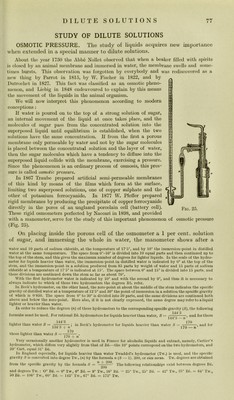
Treatise on general and industrial inorganic chemistry / by Etore Molinari ; third revised and amplified Italian edition translated by Ernest Feilman.
- Ettore Molinari
- Date:
- 1912
Licence: In copyright
Credit: Treatise on general and industrial inorganic chemistry / by Etore Molinari ; third revised and amplified Italian edition translated by Ernest Feilman. Source: Wellcome Collection.
102/734
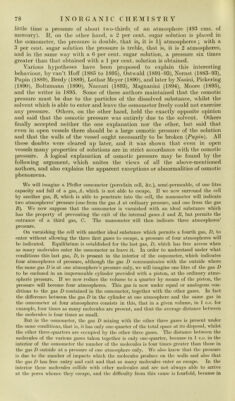
![if tlie osmotic pressure exercised by a solution containing thè molecular weiglit in graniines of a known substance in a given volume is known, and il ve tlieii dilute or concentrate Solutions of substancesof unknown molecular weiglit in thè same solvent until they exercise thè same osmotic pressure, we will theii know that equal volumes of these Solutions contain thè same number of molecules as are contained in equal volumes of thè solution of thè known substance. For liis detenniiiations de Vries used vegetable cells by immersing them in Solutions of various colicentration, and thus obtained at will various osmotic pressures. The cells of tradescantia discolor, of curcumajruhricaulis, and QYew^hlood corj^uscles (Hamburger), are well suited for this pmpose. We may see under thè microscope that if these cells are immersedin a saline solution more concentrated than thè protoplasmic li quid, thè hyaloplasm contraets. If, on thè other hand, thè saline solution is moie dilute, thè celi swells until its envelope sometimes even bursts. This phenomenon, called plasmolysis, was used by de Vries to deterniine thè molecular weiglit of various substances. hi 1887 van’t Hofì showed that isotonic (equimolecular) Solutions remain isotonic even if thè temperature is varied, and more precisely he found that thè osmotic pressure is proportionalVto thè absolute temperature, Thus to such isotonic Solutions, when very dilute,! thè generai formula may be applied wliich expresses thè laws of Boyle and Gay- Lussac, according to which thè produci of thè pressure (P) and thè volume (F) is equal to thè produci of a Constant (P) and thè absolute temperature (T), that is to say, P V = R T. PV For all gases thè Constant R is equal to 84,780 (that is, R = see p. 26). If in place of P in this formula we introduce thè osmotic pressure of a 1 per cent, sugar solution at 0° (273° absolute), that is, thè pressure of a column of mercury of 49-3 cms. equivalent to 671 gr. [that is, 49-3 x 13*6 (weight of 1 c.c. of mercury)] as was obtained by Pfeffer, we then know that thè molecular weight of sugar expressed in grammes (342) at 1 per cent. dUution will occupy a volume, F, of 34,200 c.c. and thè formula will become : ^ 671 X 34,200 ^ 273 84,100. Thus we see that thè Constant, R, deduced from thè osmotic pressure may be considered equal to thè gas Constant, and that, in fact, thè quantity of sugar in solution, if it could be transformed into a gas, would exercise a pressure equal to thè osmotic pressure of that solution. We may thus visualise this action of thè solvent by supposing it to assist in thè separation of thè sugar molecules from one another by carrying them to such a distance apart that thè same quantity of sugar will be found as would be present in thè same volume of vapour if thè solvent were absent. Or again, if we take one litre of alcohol vapoui’ which weighs about 1| grms., thè molecules are present at a certain characteristic distance from one another, which is characteristic of alcohol in thè gascous condition. If we now take another 1|^ grms, of alcohol, that is, thè same number of molecules of alcohol as before, and dissolve them in a litre of water, thè molecules of alcohol will be present at thè same distance from one another as was thè case in thè gaseous state ; and we may say in generai that thè solvents, in thè case of dilute Solutions, produco a species of gassifìcation of liquid and solid sub- stances (as had already been suggested by Rosenstiehl in 1870). The determiiiatioii of molecular weiglits by means of osmotic pressure is very suitable for all iiidiffereiit substances, but gives abiiormal results in thè case of acids, bases, and salts, especially if these are dissolved in water. We will see below how these exceptions, which are due to thè dissociation of thè dissolved molecules, ha ve been brilliantly explained. SURFACE TENSION OF LIQUIDS. At their surface, liquids contain a layer of molecules which are present under different conditions from those in thè interior of thè mass, and give rise to various phenomena which v e ma}' ‘ We iiiake thè rescrvatiou tliat thè Solutions must be very dilute, bccause this law has also a limitation and is oidy true for great dilutions, just as thè law for gases and vapours is only true when these are studied at tem- peratures far from their point of condensation.](https://iiif.wellcomecollection.org/image/b28134187_0104.jp2/full/800%2C/0/default.jpg)