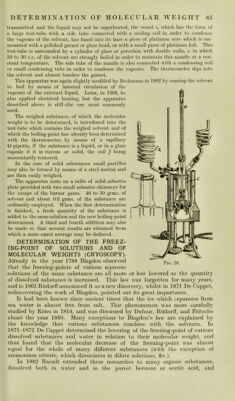
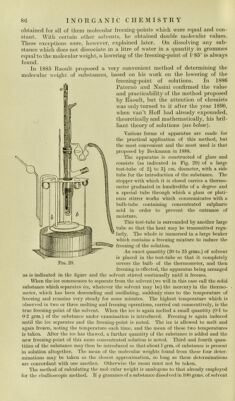
Treatise on general and industrial inorganic chemistry / by Etore Molinari ; third revised and amplified Italian edition translated by Ernest Feilman.
- Ettore Molinari
- Date:
- 1912
Licence: In copyright
Credit: Treatise on general and industrial inorganic chemistry / by Etore Molinari ; third revised and amplified Italian edition translated by Ernest Feilman. Source: Wellcome Collection.
104/734
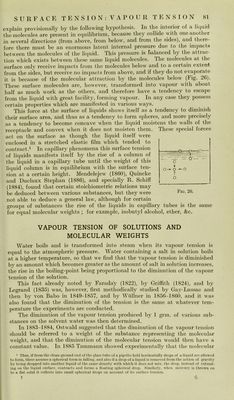
![decrease of thè vapour tensioii is equal for analogous salts dissolved in water, but notable differences were found in thè case of different salts. In 188C Raoult made numerous experiments in thè barometric vacuum, cmploying other solvents instead of water, and he obtained results of very wide and generai hearing wiiich fiilly eonfirmcd thè prophecy of Ostwald (1883). In this way we bave at our disposai another very convenient method of determining thè molecular weight of a very large nninber of substances, simply by observing thè decrease in thè vapour tension of thè solvents on dissolving sudi substances, by determiihng, that is, their relative boiling- points. This also is a limited law which is only true for very dilutc Solutions. If we denotc thè vapour tension of thè solvent by / and that of thè solution of g granimes of thè substance by then f — f' indicates thè ahsolute decrease of thè vapour tension, f -f . . wliilst —-j— indicates thè relative decrease which reniains Constant at all temperatures as was shown experi mentali y by Raoult in 1886. If we then indicate by A: a Constant which represents thè relative decrease for concentrations of 1 grm. of substance per unit volume, we will bave for g grammes : f-r ■ 9- f = k We laiow that equimolecular Solutions liave an equal vajjour tension, that is to say, thè molecular lowering of thè vapour tension of various substances dissolved in thè sanie solvent is a Constant quantity, or in order to obtain an equal decrease of thè vapour tension it is necessary that a given quantity of a dissolved substance should be flissolved in quantities of different solvents which are in thè sanie proportion to one another as thè respective molecular weights of these substances. Now thè lowering of thè vapour tension is independent of thè nature, of thè solvent and of thè dissolved substance, and is a function of thè number of molecules of thè solvent {N) and of thè substance {n) only. The ratio between thè vapour tension of thè solution and that of thè solvent is thè same as that which exists between thè number of thè molecules of thè solvent {N) r N and thè number of thè molecules of thè solution, N + n, that is, — = and as N + n^ thè relative decrease of thè vapour tension of a solution corresponds to thè relative number n \ f - f' n of thè molecules of thè dissolved substance we bave -, that is. N + n’ / N + id thè relative decrease of thè vapour tension of a solution is equal to thè ratio between thè number of molecules of thè dissolved substance and thè total number of molecules in thè solution. Silice, however, we do not in practice know thè absolute number of thè molecules, we must introduce into this formula thè corrcsponding relative number, which we can easily do, and can always find it by dividing thè weight of thè substance (<7) and of thè solvent (G) by thè corrcsponding molecular weights (m and M), so that — = n and TYb G —= N ; on substituting these values for those really knowii in thè preceding generai formula, and taking, for simplicity’s sake, a quantity of solvent in grammes expressed by thè molecular weight so that JV = 1, we obtain thè formula : or inversely thè ratio : / f-r f g + m 9 m 9 j 9^ 9 +'ni m , and we thus obtain thè following vaine of m f-r 9 _ ji_ _ _ ji_ _ iijzjr] ^ jfL ~f-r ^ f-r ^\f-rl f-r m f'9 J u Now by means of this generai formula m = j _ we can always determine thè piolecular weight of any subitanee,](https://iiif.wellcomecollection.org/image/b28134187_0106.jp2/full/800%2C/0/default.jpg)