Treatise on general and industrial inorganic chemistry / by Etore Molinari ; third revised and amplified Italian edition translated by Ernest Feilman.
- Ettore Molinari
- Date:
- 1912
Licence: In copyright
Credit: Treatise on general and industrial inorganic chemistry / by Etore Molinari ; third revised and amplified Italian edition translated by Ernest Feilman. Source: Wellcome Collection.
30/734
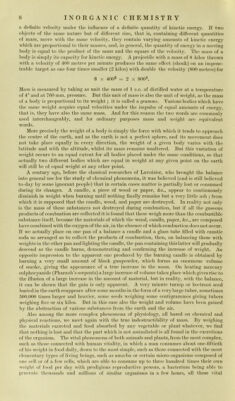
![a definite velocity nnder thè infiiience of a definite quantity of kinetic energy. If two ohjects of tlic sanie nature biit of different size, that is, containing difTerent quantities of mass, movo with the samo volocity, tlioy oontain varying amonnts of kinotic energy wliicli aro proportional to their massos, and, in gonoral, tlio qnantity of cnorgy in a moving l)ody is cqnal to tlio jirodnct of the mass and tlie sqnare of tiio volocity. The mass of a body is simply its capacity for kinotic cnorgy. A projectilc with a mass of 8 kilos thrown witli a volocity of 400 mctros por minuto produces the same cffcct (shock) on an impcne- trablc target as ono foiir timos smallcr (2 kilos) with doublé the volocity (800 metres) for 8 X 4002 = 2 X 8002. Mass is moasured by taldng as unit the mass of 1 c.c. of distillcd water at a temperature of 4° and at 7G0 mm. pressure. But this unit of mass is also thè unit of weight, as the mass of a body is proportional to its weight ; it is called a gramme. Various bodies which bave the same weight acquire equal velocities under thè impulse of cqual amounts of energy. that is. they have also the same mass. And for this reason thè two words are commonlv used interchangeably, and for ordinary purposes mass and weight are cquivalent words. More precisely the weight of a body is simpl}^ the force with which it tends to approach the centre of the earth, and as the earth is not a perfect sphere, and its movement does not take place equally in every direction, thè weight of a given body varies with the latitude and with the altitude, whilst its mass remains unaltercd. But this variation of weight occurs to an equal extent for all bodies placed under the same conditions, so that actually two different bodies which are equal in weight at any given point on the earth will stili be of equal weight at any other point. A century ago, before thè classical researches of Lavoisier, who brought the balance into generai use for the study of Chemical phcnomeha, it was believed (and is stili belicved to-day by some ignorant people) that in certain cases matter is partially lost or consumed during its changes. A candle, a piece of wood or paper, &c., appear to continuously diminish in weight when burning until nothing finally remains but a very little asli ; from which it is supposcd that the candle, wood, and paper are dcstroycd. In rcality not only is thè mass of these substances not destroyed diming combustion, but if all the gaseous Products of combustion are collected it is found that these weigh more than the combustible substance itself, because thè materials of which the wood, candle, paper, &c., are composed have combined with the oxygcn of thè air, in thè absence of which combustion does not occm-. If wc actually place on ono pan of a balance a candle and a glass tube filled with caustic soda so arranged as to collect the produets of combustion, then, on balancing these vith weights in the other pan and lighting the candle, thè pan containing this latter will gradually dcscend as thè candle burns, demonstrating and confirming the increaso of weight. An opposite impression to the apparent one produced bj'^ the burning candle is obtaincd by burning a very small amount of black gunpowder, which forms an cnormous volume of smoke, giving the appearanco of a true increaso in the mass. On heating mcrcur}’ sulphocyanido (Pharaoh’s serpents) a largo increaso of volume takes place which gives rise to the illusion of a largo increaso in the amount of material, but in rcality, with thè balance, it can bc shomi that the gain is onlj^ apparent. A very minute turni]) or bcctroot seed buried in the earth reappears after some months in the forni of a very largo tubcr, sometimes .500,OOt) times larger and heavicr, some seeds weighing some centigrammes giifing tubers weighing five or six kilos. But in this case also thè weight and volume have been gained liy thè abstraction of various substances from the earth and thè air. Also among thè more complex phenomena of physiology, all based on Chemical and physical reactions, we mect again ivith thè true indestructibility of mass. By weighing thè materials exereted and food absorbed by any vcgetable or plant whatever, we find that nothing is lost and that thè part which is not assimilated is all found in the exeretions of thè organism. The vital phenomena of both animals and plants, from thè most complex, sudi as those connected with human vitality, in which a man consumes ahout onc-fiftieth of bis wc'igbt in food daily, down to the most sini])le, sudi as those connected with the most dementary types of living boings, sudi as animba or ecrtain micro-organisms composed of one celi or of a few cdls, which are able to consume up to three hundred times their own weight of food por day with jirodigious re])roductivc ]iowers, a bacterium being able to generate thousands and niillions of siiiiilar organisms in a few hours, all these vital](https://iiif.wellcomecollection.org/image/b28134187_0032.jp2/full/800%2C/0/default.jpg)