Treatise on general and industrial inorganic chemistry / by Etore Molinari ; third revised and amplified Italian edition translated by Ernest Feilman.
- Ettore Molinari
- Date:
- 1912
Licence: In copyright
Credit: Treatise on general and industrial inorganic chemistry / by Etore Molinari ; third revised and amplified Italian edition translated by Ernest Feilman. Source: Wellcome Collection.
71/734
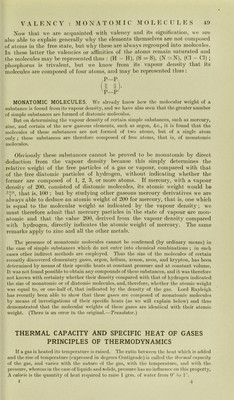
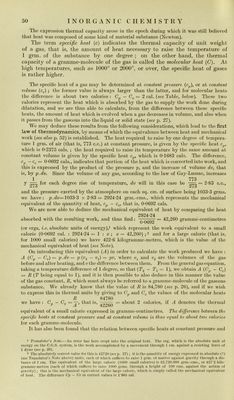
![New tliat WG are acquainted witli valency and its significaiioii, a\c are also able lo explain generally why thè elements themselves are not composed of atoins in thè free state, bnt why these are ahvays regrouped into molecules. In these latter thè valencies or affinities of thè atoms remain saturated and thè molecules inay be represented thus : (H - H), (S = S), (N ^N), (CI - Cl) ; phosphoriis is trivalent, bnt we know from its vapour density that its molecules are composed of four atoms, and may be represented thus : P—Pv Il 11). \p_p/ MONATOMIC MOLECULES. Wc already know liow the molccular wciglit of a substance is foimd from its vapour density, and we bave also scen that thè greater number of simple snbstances are formed of diatoinic molecules. Bnt on determining the vapour density of ccrtain simple substances, sudi as mercury, zinc, and certain of the new gaseous elements, sudi as argon, &c., it is found that the molecules of these substances aro not formed of tivo atoms, but of a single atoni oiily ; these substances aro therefore composed of free atoms, that is, of monatomic molecules. ObvioLisly these substances cannot be ]3roved to be monatomic by direct deduction from thè vapour density because this simply determines the relative weight of the free particles of a gas or vapour, compared with that of the free diatomic particles of hydrogen, without indicating whether the former are composed of 1, 2, 3, or more atoms. If mercury, with a vapour density of 200, consisted of diatomic molecules, its atomic weight would be ^1^, that is, 100 ; but by studying other gaseous mercury derivatives we are always able to deduce an atomic weight of 200 for mercury, that is, one which is equal to the molecular weight as indicated by thè vapour density ; we must therefore admit that mercury particles in thè state of vapour are mon- atomic and that the vaine 200, derived from the vapour density compared with hydrogen, directly indicates the atomic weight of mercury. The sanie remarks apply to zinc and all the other metals. The presence of monatomic molecules cannot be confirmed (by ordinary means) in the case of simple substances wliich do not entcr into Chemical combinations ; in sudi cases other indirect methods are employed. Thus the size of thè molecules of certain recently discovered elementary gases, argon, lielium, xenon, neon, and lo’ypton, has been deterniined by means of their specific heats at Constant pressure and at Constant volume. It was not found possible to obtain any compounds of these substances, and it was therefore not knovTi with certainty whether their density compared with that of hydrogen indicated the size of monatomic or of diatomic molecules, and, therefore, whether the atomic weight was equal to, or one-half of, that indicated by the density of thè gas. Lord Rayleigh has recently been able to show that these gases are composed of monatomic molecules by means of investigations of their specific heats (as we will explain below) and thus demonstrated that the molecular weights of these gases are identical with their atomic weight. (There is an error in the originai.—Translator.) THERMAL CAPACITY AND SPECIFIC HEAT OF GASES PRINCIPLES OF THERMODYNAMICS If a gas is lieated its temperature is raised. The ratio between thè heat which is added and the rise of temperature (expressed in degrees Centigrade) is called the thermal capacity of the gas, and varies with the nature of the gas, witli the temperature, and with the pressure, whereas in the case of liquids and solids, pressure has no intluenco on this property. A calorie is the quantity of heat required to raise 1 gnu. of water from 0° to 1°. I 4](https://iiif.wellcomecollection.org/image/b28134187_0073.jp2/full/800%2C/0/default.jpg)