Treatise on general and industrial inorganic chemistry / by Etore Molinari ; third revised and amplified Italian edition translated by Ernest Feilman.
- Ettore Molinari
- Date:
- 1912
Licence: In copyright
Credit: Treatise on general and industrial inorganic chemistry / by Etore Molinari ; third revised and amplified Italian edition translated by Ernest Feilman. Source: Wellcome Collection.
82/734
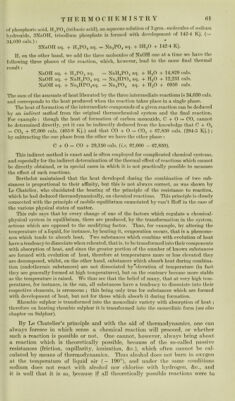
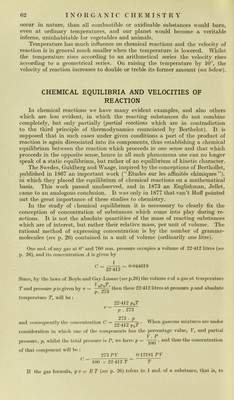
![Iliade to occur in a closed metallic receiver wliich is immersed in a measured quantity ot‘ ^\ate^, tlie temperature of which is measured botli before and after tlie reaction. Tliere is a generai agreement to-day to refer tlie thermal tonality of a substance or of a Chemical reaction to gramme-molecules of thè substances in question {see mol., p. 26), or in thè case of metals to gramme-atoms ; they may aiso be referred to gramme-equivalents. We will now follow some reactions thermochemically : Pb + I2 = Pblg + 39,800 cab Tkis cquatioii sigiiifies that thè internai energy of 207 grms. of Pb (atomic weight 207) + thè internai energy of 2 x 127 grms. of lodine (atomic weight 127) = thè internai energy of 460*6 grms. of Pblg (molecular weight) + 39,800 calories developed in thè reaction. Thus Pbig = — 39,800 cals., that is, Pbl contains 39,800 calories less than thè Iree components and, in order to regain Pb and I from it, it would be necessary to employ 39,800 cals. which were evolvcd dming its formation. In thè forniation of 18 grms. (mol. wt.) of water at 0° starting from 2 grms. of hychogen and 16 grms. of oxygen, 68,400 cals. are developed, and thus HgO liquid = — 68,400 cals. (or 286 Kj. ; as 1 Kj. = 239 cals.). If, on thè other hand, 18 grms. of water vapour at 100° is under consideration it is necessary to deduct 100 calories which are developed for each gramme of water when cooled from 100° to 0° and also thè heat of evaporation which is 537 cals. for each gramme of water, and thè expression now becomes : H^O vapour = — 57,000 cals. [i.e., 68,400 — (637 x 18)] also referred to 18 grms. But this resdlt, and also that obtained in thè case of liquid water, must be stili further corrected to allow for thè fact that, starting from gaseous substances, and in fact from one mol. (22,412 litres == 1 grm.) of hydrogen and ^ mol. of oxygen (11,206 litres), we obtain liquid water, so that there has been a diminution of volume of 1^ mols., that is, 33*618 litres, and thè corresponding quantity of heat has thus been developed and can be calculated because we know that 1 litre-atmosphere corresponds to 24*19 cals. {see p. 27). Thus thè true thermal tonality of thè formation of HgO liquid will be : 68,400 - (24*10 X 33*618) = 68,400 - 814 = 67,586 cals. The acciurate thermal tonality for HgO vapom* will be 57,000 cals. diniinished by thè heat corresponchng to | mol. by volume, because 1 mol. of water vapom* finally results from 1^ mols. of hydrogen and oxygen. When a gas reacts 011 a liquid it is sometimes necessary to take thè heat of solution of thè gas in thè liquid into account. Thus if we allow aqueous Solutions of potassium hydroxide and HCl to react we will have thè following equation, thè thermal tonahty of which in this case expresses thè heat of neutralisation : KOH aq + HCl aq = KCl aq + H^O + 57*35 Kj, (= 13,700 cals,) If an aqueous solution of KOH reacts directly with HCl gas thè equation will be : KOH aq + HCl gas = KCl aq + H^O + 129*91 Kj. (= 31*060 cals.) According to this second equation we have a development of 72*38 Kj. (= 17,360 cals.) more heat, and this expresses thè heat of solution of HCl gas in water. In thè thermal elìect which results from these reactions thè work of dissociation of thè reacting molecules into thè corresponding simple atonis, a process which requires considerable quantities of heat, is also included. Thus, thè heat which is actually mcasmed represents thè dilference between thè heats of combination of thè reacting atoms and thè heats of dissociation of thè reacting molecules. The second law of thcrmochemistry (of Hess) is also called thè law of thè Constant sum of thè heat eliects, and says that thè linai thermal etì’ect of a complete roaction is cqual to that obtained it thè reaction occms in one phase, Avhatever thè nunibcr of phases tlnough which it actually passes, that is, thè diflerence of energy between two States of a Chemical System is independent of the cycle through which it has passed fiom thè one state to the other. If, for example, we add to an aqueous solution of 1 grm.-molecule](https://iiif.wellcomecollection.org/image/b28134187_0084.jp2/full/800%2C/0/default.jpg)