Health lectures for the people. Third series. Delivered in Edinburgh during the winter of 1882-83.
- Date:
- 1883
Licence: Public Domain Mark
Credit: Health lectures for the people. Third series. Delivered in Edinburgh during the winter of 1882-83. Source: Wellcome Collection.
Provider: This material has been provided by the Royal College of Physicians of Edinburgh. The original may be consulted at the Royal College of Physicians of Edinburgh.
37/232 page 27
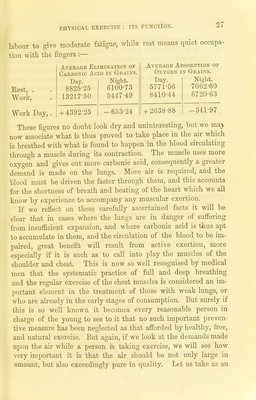
![labour to give moderate fatigue, while rest means quiet occupa- tion with the fingers :— Kest, . Work, AVEBAGE EL] Carbonic Ac Day. 8825-25 13217-50 [MINATION OF LD IN Grains. Night. 6100-73 5447-49 Average Ai Oxygen i Day. 5771-56 8410-44 iSORPTION CI- N Grains. Night. 7062-60 6720-63 + 4392-25 -653-24 + 2638-88 -341-97 Work Day, These figures no doubt look dry and uninteresting, but we ma> now associate what is thus proved to take place in the air which is breathed with what is found to happen in the blood circulating through a muscle during its contraction. The muscle uses more oxygen and gives out more carbonic acid, consequently a greater demand is made on the lungs. More air is required, and the blood must be driven the faster through them, and this accounts for the shortness of breath and beating of the heart which we all know by experience to accompany any muscular exertion. If we reflect on these carefully ascertained facts it will be clear that in cases where the lungs are in danger of suffering from insuflacient expansion, and where carbonic acid is thus apt to accumulate in them, and the circulation of the blood to be im- paired, great benefit will result from active exertion, more especially if it is such as to call into play the muscles of the shoulder and chest. This is now so well recognised by medical men that the systematic practice of full and deep breathing and the regular exercise of the chest muscles is considered an im- portant element in the treatment of those with weak lungs, or who are already in the early stages of consumption. But surely if this is so well known it becomes every reasonable person in charge of the young to see to it that no such important preven- tive measure has been neglected as that afforded by healthy, free, and natural exercise. But again, if we look at the demands made upon the air while a person is taking exercise, we will see how very important it is that the air should bo not only large in amount, but also exceedingly pure in quality. Let us take as an](https://iiif.wellcomecollection.org/image/b21908394_0037.jp2/full/800%2C/0/default.jpg)