[Report 1960] / Medical Officer of Health, Brixworth R.D.C.
- Brixworth (England). Rural District Council.
- Date:
- 1960
Licence: Attribution 4.0 International (CC BY 4.0)
Credit: [Report 1960] / Medical Officer of Health, Brixworth R.D.C. Source: Wellcome Collection.
33/46 page 29
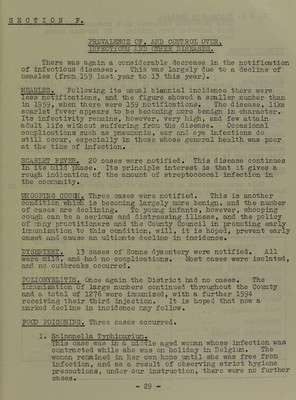
![PREVALENCE OE. MID CONTROL OVER, INEECTIOUS AND OTHER DISEASES. There was again a considerable decrease in the notification of infectious diseases. This was largely due to a decline of measles (from 159 last year to 15 this year). MEiVSLES. Eollov/ing its usual biennial incidence there were less no-tifications, and the figure showed a smller number than in 1959, when there were 159 notifications. The disease, like scarlet fever appears to be becoming more benign in. character. Its infectivity remains, however, very high, and few attain adult life without suffering from the disease. Occasional complications such as pneumonia, ear and eye iafections do still occur, especially in those v/hose general health was poor at the time of infection. SCAKLET EEVER. 20 cases were notified. This disease continues in its mild phase. Its principle interest is that it gives a rough indication of the amount of streptococcal infection in the community. \?E00Pn\fG C0U(5-I. Three cases were notified. This is another condition which is becoming largely more benign, and the number of cases are declining. To young infants, however, v/hooping cou^ can be a serious and distressing illness, and the policy of mny practitioners and the County Council in promoting early immunization to this condition, will, it is hoped, prevent early onset and cause an ultimate decline in incidence. DYSSi^TTERY. 13 cases of Sonne dysentery were notified. All were mild, and had no complications. Most cases were isolated, and no outbreaks occurred. PQLIO])/IYELITIS. Once again the District had no cases. The immunization of large numbers continued throughout the County and a total of 1276 were immunized, with a further 1594 receiving their third injection. It is hoped that now a marked decline in incidence may follow. EOCD POISONING-. Three cases occurred. 1. Salmonella Typhimurim. This case was in a middle aged woman whose infection was contracted while she was on holiday in Belgium. The woman remained in her own home until she was free from infection, and as a result of observing strict hygiene precautions, under our instruction, there were no further cases.](https://iiif.wellcomecollection.org/image/b28957878_0033.jp2/full/800%2C/0/default.jpg)