A report on excisions of the head of the femur for gunshot injury / War Department, Surgeon General's Office.
- Date:
- 1869
Licence: Public Domain Mark
Credit: A report on excisions of the head of the femur for gunshot injury / War Department, Surgeon General's Office. Source: Wellcome Collection.
Provider: This material has been provided by the Royal College of Physicians of Edinburgh. The original may be consulted at the Royal College of Physicians of Edinburgh.
40/152 page 38
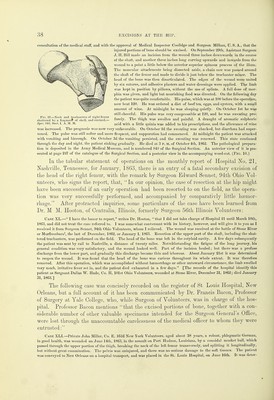
![consultation of the medical staff, and with the approval of Medical Inspector Coolidge and Surgeon Milhau, U. S. A., that the injured portions of bone should be excised. On September 29th, Assistant Surgeon J. H. Bill made an incision from the wound three inches downwards in the course of the shaft, and another three inches long curving upwards and inwards from the wound to a point a little below the anterior superior spinous process of the ilium. The muscular attachments being dissected aside, a chain saw was passed around the shaft of the femur and made to divide it just below the trochanter minor. The head of the bone was then disarticulated. The edges of the wound were united by six sutures, and adhesive plasters and water dressings were applied. The limb was kept in position by pillows, without the use of splints. A full dose of mor- phia was given, and light but nourishing food was directed. On the following day the patient was quite comfortable. His pulse, which was at 100 before the operation, now beat 120. He was ordered a diet of beef tea, eggs, and oysters, with a small amount of wine. At midnight he was sleeping quietly. On October 1st he was still cheerful. His pulse was very compressible at 120, and he was sweating pro- Fir,. 10.—Neck and trochanters of right femur r , ,t. , , . ,, . . , , . „ ,. , , shattered by a fragment of shell, and excised.— tusely. 1 he thigh was swollen and painful. A draught of aromatic sulphuric Spec. 840, Sect. 1, A. M. M. ac;<j -vvlt.il a little quinia was added to his prescriptions, and the allowance of wine was increased. The prognosis was now very unfavorable. On October 2d the sweating was checked, but diarrhoea had super- vened. The pulse was still softer and more'frequent, and suppuration had commenced. At midnight the patient was attacked with vomiting and hiccough. On October 3d the vomiting persisted, and the sweating was renewed. This state continued through the day and night, the patient sinking gradually. He died at 3 P. M. of October 4th, 1862. The pathological prepara- tion is deposited in the Army Medical Museum, and is numbered 840 of the Surgical Section. An anterior view of it is pre- sented at page 247 of the catalogue of the Surgical Section, and a posterior view in the accompanying wood-cut. (Fig. 10.) In the tabular statement of operations on the monthly report of Hospital No. 21, Nashville, Tennessee, for January, 1863, there is an entry of a fatal secondary excision of the head of the right femur, with the remark by Surgeon Edward Sennet, 94th Ohio Vol- unteers, who signs the report, that, In our opinion, the case of resection at the hip might have been successful if an early operation had been resorted to on the field, as the opera- tion was very successfully performed, and accompanied by comparativly little hemor- rhage. After protracted inquiries, some particulars of the case have been learned from Dr. M. M. Hooton, of Oentralia, Illinois, formerly Surgeon 56th Illinois Volunteers: Case XL.—I have the honor to report, writes Dr. Hooton, that I did not take charge of Hospital 21 until March 10th, 1863, and did not treat the case referred to. I was somewhat conversant with its history, however, and will give it to you as I received it from Surgeon Sennet, 94th Ohio Volunteers, whom I relieved. The wound was received at the battle of Stone Eiver or Murfreesboro', the last of December, 1862, or January 1, 1863. Resection of the upper part of the shaft, including the shat- tered trochanters, was performed on the field. The head of the bone was left in the cotyloid cavity . A few days subsequently the patient was sent by rail to Nashville, a distance of twenty miles. Notwithstanding the fatigue of the long journey, his general condition was very satisfactory, and the wound looked well. Part of the incision healed; but there was a profuse discharge from the lower part, and gradually this discharge became thin and ichorous. About January 21st it Was determined to reopen the wound. It was found that the head of the bone was carious throughout its whole extent. It was therefore removed. After this operation, which was accomplished without hemorrhage or other untoward circumstance, the limb swelled very much, irritative fever set in, and the patient died exhausted in a few days. [The records of the hospital identify this patient as Sergeant Dallas W. Hade, Co. H, 101st Ohio Volunteers, wounded at Stone River, December 31, 1862; died January 31, 1863.] The following case was concisely recorded on the register of St Louis Hospital, New Orleans, but a full account of it has been communicated by Dr. Francis Bacon, Professor of Surgery at Yale College, who, while Surgeon of Volunteers, was in charge of the hos- pital. Professor Bacon mentions that the excised portions of bone, together with a con- siderable number of other valuable specimens intended for the Surgeon General's Office, were lost through the unaccountable carelessness of the medical officer to whom they were entrusted: Case XLI.—Private John Miller, Co. E, 162d New York Volunteers, aged about 38 years, a robust, phlegmatic German, in good health, was wounded on June 14th, 1863, in the assault on Port Hudson, Louisiana, by a conoidal musket ball, which passed through the upper portion of the thigh, breaking the neck of the left femur transversely, and splitting it longitudinally, but without great comminution. The pelvis was uninjured, and there was no serious damage to the soft tissues. The patient was conveyed to New Orleans on a hospital transport, and was placed in the St. Louis Hospital, on June 16th. It was deter-](https://iiif.wellcomecollection.org/image/b21971389_0042.jp2/full/800%2C/0/default.jpg)