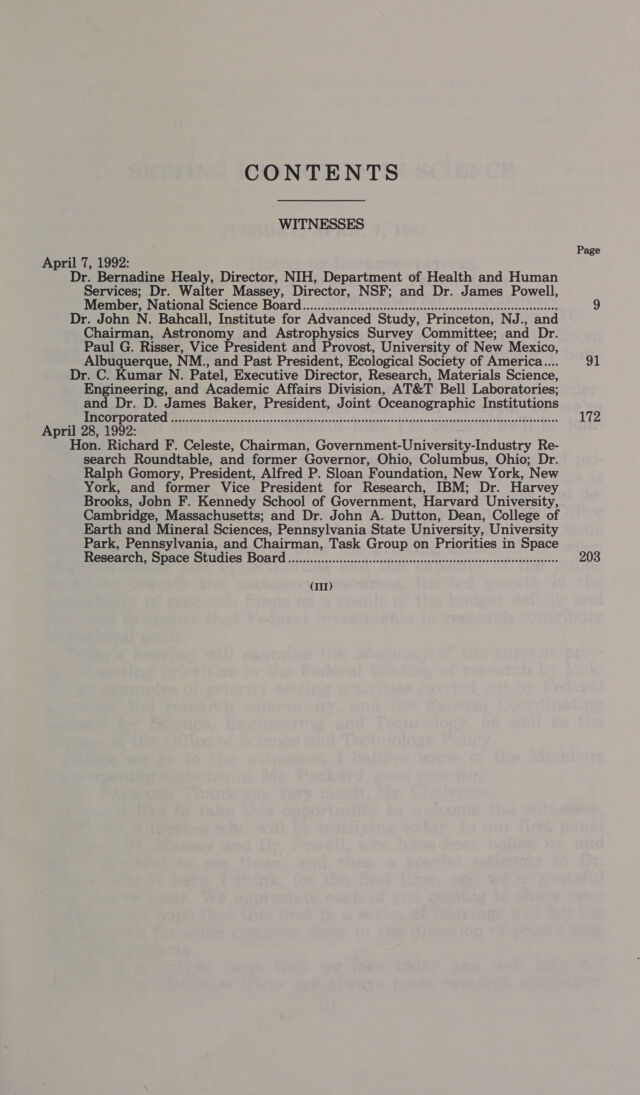
Setting priorities in science : hearings before the Subcommittee on Science of the Committee on Science, Space, and Technology, U.S. House of Representatives, One Hundred Second Congress, second session, April 7, 28, 1992.
- United States. Congress. House. Committee on Science, Space, and Technology. Subcommittee on Science
- Date:
- 1992
Licence: Public Domain Mark
Credit: Setting priorities in science : hearings before the Subcommittee on Science of the Committee on Science, Space, and Technology, U.S. House of Representatives, One Hundred Second Congress, second session, April 7, 28, 1992. Source: Wellcome Collection.
16/272 page 12
![The institutes will be responsible for implementing specific ini- tiatives, virtually all of which will be pertinent to their individual research missions, and at a broader level, we want our budget to be driven by the strategic plan. In the past, the budget has generally focused on mechanisms rather than on cross-cutting opportunities in science. In the future, we will cast our budget in terms of scien- tific programs and not mechanisms. In implementing the plan, we will continue to reaffirm the prin- ciple of high quality, investigator-initiated research, which has been the hallmark and the success of NIH. Also, we are committed to maintaining the balance and diversity of our research portfolio at the same time that we emphasize certain areas of opportunity, such as molecular medicine. We are relying on the extramural community to play a continu- ing role in the development of our plan. With the completion of the regional meetings, our next step is to hold a national task force meeting of 150-200 extramural scientists. In June, panels composed of key non-Federal scientists will meet to review, with NIH leader- ship, issues relating to the five objectives that I have just outlined. The panels will also focus on training and infrastructure issues, cost management, peer review, and the development of a scientific code of ethics. Following the task force meetings, a third Director’s retreat will be held to develop an overarching summary of issues raised in all of these earlier meetings. This retreat will involve members of the extramural scientific community, lay advisors representing the public, the NIH leadership, as well as representatives from other constituency groups. In conclusion, Mr. Chairman, through our strategic plan, we are creating the NIH of tomorrow and hoping to shape the future of biomedical research. We have invited the public research communi- ty and the American public to participate in our planning, because we recognize the impact that the NIH has on their lives. We also recognize that the opportunities for major achievements in biome- dicine and the life sciences have never been greater, and we want to ensure that the United States will be in a position to take full advantage of these opportunities. Thirty years ago, President Kennedy pointed out that “...those who look only to the past or the present are certain to miss the future.” The strategic plan will be NIH’s window to the future, a means by which we can more effectively address future challenges and sustain and strengthen biomedical research and our Nation’s economy. We fully recognize that the ultimate beneficiaries of our efforts must be the American people. We look forward to working with you and with other Members of Congress as we try to create the NIH of tomorrow. Thank you. (The prepared statement of Bernadine Healy follows:]](https://iiif.wellcomecollection.org/image/b32218229_0016.jp2/full/800%2C/0/default.jpg)