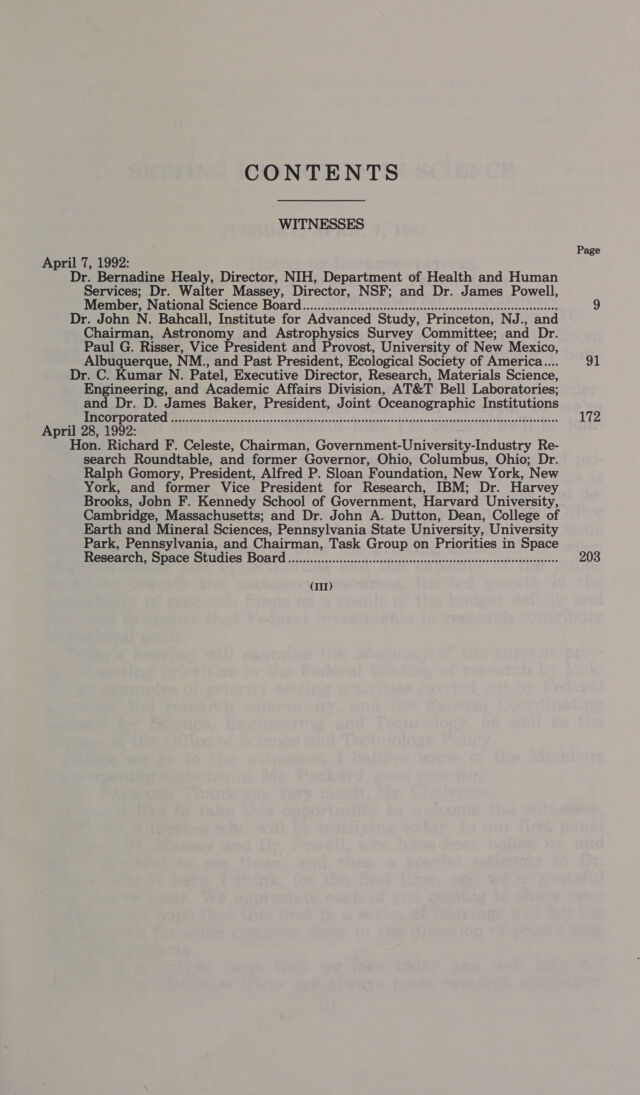
Setting priorities in science : hearings before the Subcommittee on Science of the Committee on Science, Space, and Technology, U.S. House of Representatives, One Hundred Second Congress, second session, April 7, 28, 1992.
- United States. Congress. House. Committee on Science, Space, and Technology. Subcommittee on Science
- Date:
- 1992
Licence: Public Domain Mark
Credit: Setting priorities in science : hearings before the Subcommittee on Science of the Committee on Science, Space, and Technology, U.S. House of Representatives, One Hundred Second Congress, second session, April 7, 28, 1992. Source: Wellcome Collection.
243/272 page 239
![Mr. Chairman, members of the Subcommittee. Thank you for inviting me to testify at these important hearings on behalf of the Task Group on Setting Priorities in Space Research, a committee of the Space Studies Board, National Research Council. As you know, we have just released a report, Setting Priorities for Space Research - Opportunities and Imperatives’. That report is the culmination of a two-year study which focused on whether the space research community should have a role in setting priorities for those scientific objectives and initiatives which comprise the space science and applications component of the nation’s civil space program. Our conclusion was a resounding Yes. Not only is it desirable -- it is imperative. That it took nearly two years to convince ourselves, the Board, and other colleagues from the space community of the validity of this conclusion indicates the sensitivity and difficulty of this issue. In our deliberations, we were inspired by a quotation from Metternich brought to us by a task group member, Buddy McKay -- one of your former colleagues, now Lt. Governor of Florida. [Policy] is like a play in many acts, which unfolds inevitably once the curtain is raised. To declare that the performance will not take place is an absurdity. The play will go on, either by means of the actors...or by means of the spectators who mount the stage. In my remarks today, I will set the context for our report, give a brief overview of its conclusions, and outline how we plan to approach the second phase of this study -- by far the more difficult enterprise. THE KEY QUESTIONS IN SETTING AN AGENDA Each of you is well aware that, in sum, the requirements and opportunities competing for federal support far exceed available funding. We know that too. We also know that scientific research is an investment in this nation’s future, not an entitlement program. In our report, we document a wide array of remarkable achievements of the U.S. space research program over the past thirty years. We go on to describe some of the abundant opportunities that exist now and for the future. NASA charts depicting funding levels required just to complete the ongoing program, let alone begin new projects, are a graphic reminder of the very real need to make difficult choices. The community of scientists engaged in research in space must reach a consensus on priorities and contribute to the formulation of an agenda for space research ; Space Studies Board, National Academy Press, 1992, Available from the Board. 2](https://iiif.wellcomecollection.org/image/b32218229_0243.jp2/full/800%2C/0/default.jpg)