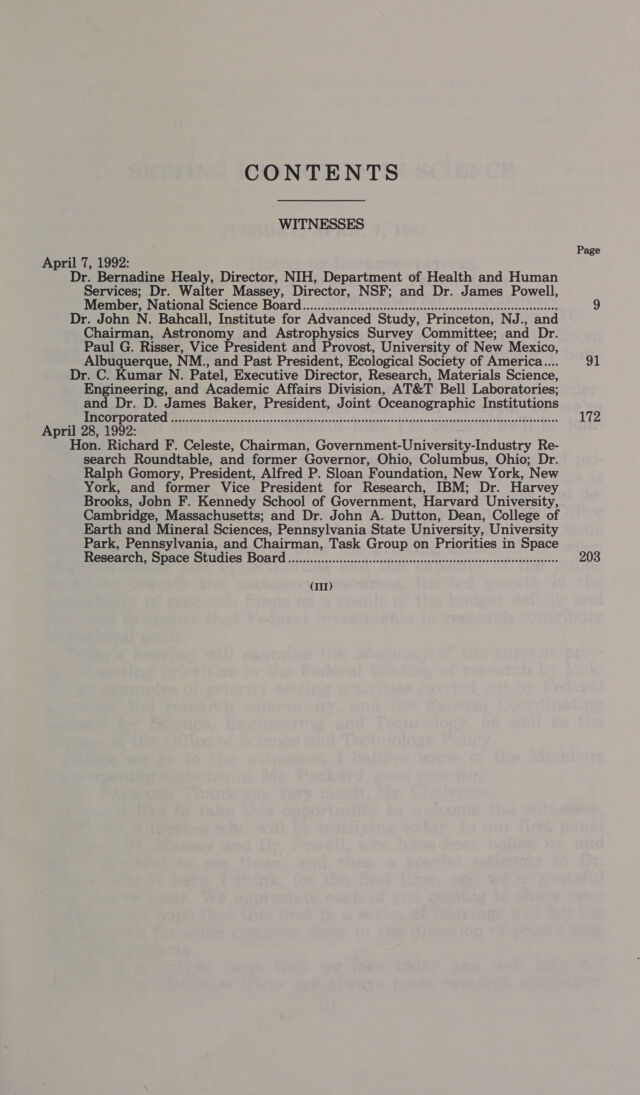
Setting priorities in science : hearings before the Subcommittee on Science of the Committee on Science, Space, and Technology, U.S. House of Representatives, One Hundred Second Congress, second session, April 7, 28, 1992.
- United States. Congress. House. Committee on Science, Space, and Technology. Subcommittee on Science
- Date:
- 1992
Licence: Public Domain Mark
Credit: Setting priorities in science : hearings before the Subcommittee on Science of the Committee on Science, Space, and Technology, U.S. House of Representatives, One Hundred Second Congress, second session, April 7, 28, 1992. Source: Wellcome Collection.
5/272 page 1
![SETTING PRIORITIES IN SCIENCE TUESDAY, APRIL 7, 1992 House OF REPRESENTATIVES, COMMITTEE ON SCIENCE, SPACE, AND TECHNOLOGY, SUBCOMMITTEE ON SCIENCE, Washington, D.C. The subcommittee met, pursuant to call, at 10:00 a.m., in Room 2325, Rayburn House Office Building, Hon. Rick Boucher [chair- man of the subcommittee] presiding. Mr. Kopetsk1. (Presiding.) The subcommittee will come to order. This morning Chairman Boucher has been delayed, so we’re going to begin this hearing without him. I’m certain he’ll be join- ing us shortly. This is the first of a series of two hearings on the process of pri- ority setting for federally-funded research. This set of hearings is designed to assess the effectiveness of the current process and de- velop recommendations for improvement. As stated in a 1991 Office of Technology Assessment report, the renewed interest in this issue stems in part from concerns over the growing mismatch between research needs and opportunities and the capacity of the public sector to provide the necessary resources, limited growth in the availability of research funds as a result of the budget deficit, and the need to ensure that Federal investments in research contribute to national goals. Today’s hearing will examine the adequacy of the current proc- ess of setting priorities in the Federal funding of research by look- ing at examples of priority setting activities carried out by Federal agencies, the research community, and the Federal Coordinating Council for Science, Engineering and Technology, as well as the process of the Office of Science and Technology Policy. Before we go to the witnesses, I believe some of the Members have opening statements. Mr. Packard, good morning. Mr. Packarp. Thank you very much, Mr. Chairman. I would like to take this opportunity to welcome the witnesses, all of the witnesses who will be testifying today. In our first panel we have Dr. Massey and Dr. Powell, who have been before us, and we're grateful to see them, and then a special welcome to Dr. Healy, who is here, I think, for the first time, and we’re grateful that you’ve come. We appreciate each of you coming to share your insights and hope that this first in a series of hearings will lay the groundwork for some concrete steps in the direction of prioritizing scientific projects. This is a critical issue that we face today and well into the future. Why? Because there are always more research opportuni-](https://iiif.wellcomecollection.org/image/b32218229_0005.jp2/full/800%2C/0/default.jpg)