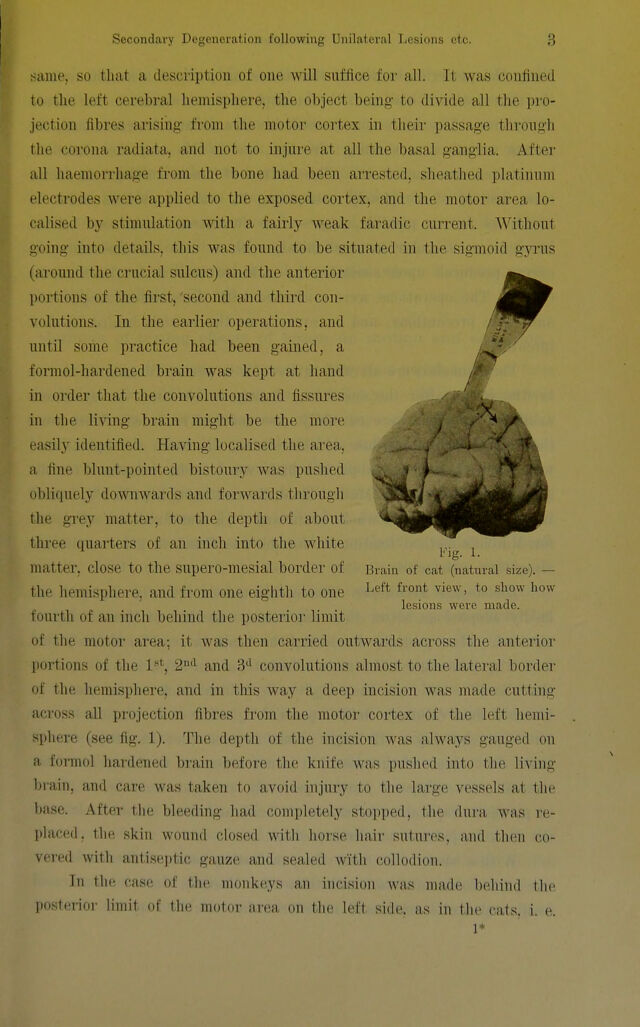
Secondary degeneration following unilateral lesions of the cerebral motor cortex / by Sutherland Simpson.
- Sutherland Simpson
- Date:
- 1902
Licence: In copyright
Credit: Secondary degeneration following unilateral lesions of the cerebral motor cortex / by Sutherland Simpson. Source: Wellcome Collection.
Provider: This material has been provided by The University of Glasgow Library. The original may be consulted at The University of Glasgow Library.
23/38 page 23
![generated crusta. What particular region of the cortex they take origin from has not been determined and what tlieir significance is I am imable to say. It may be that tliey are indirectly connected tlfrough the grey matter of the anterior coi'pora qnadrigemiiia with the nuclei of the nerves of the eye muscles situated in this region (nuclei of 3^'^ and i^^ nerves); that is, short neiu-ones may be inter- polated between the terminations of these fibres in the anterior cor- pora quadrigemina and the cells of origin of the fibres of the oculo- motor and trochlear nerves. In this connection it will be interesting to determine whether they come from the head and eyes area of the motor cortex. Another possibility is that they end in relation to tlie cells of some other tract or tracts which take origin in the anterior corpora quadrigemina and pass down to lower levels. These are points stiU to be investigated. No one, so far as I know, has previously called attention to the ex- ceedingly large amount of fine degeneration which occurs amongst the cells of the nuclei pontis following motor lesions with the exception of Dejerine and Long [17] in an article published in 1898. This con- tains a record of the examination of material from five cases of cere- bral hemiplegia smtable for the Marclii method. They say: — In the grey substance of the pons the very fine and very numerous granules which we have observed in two of the cases indicate a degeneration of collateral and terminal fibres at this level, and this fact explains to us the atrophy of the grey substance of the pons which one sees in old degenerations of the cms cerebri. Sherrington [15] (1890) states that — the islanded grey masses in the pons lying close to the fibre bundles of the crustal tracts among the deep transverse pontal fibres in monkeys is one of the regions of grey matter in which in association with pyramidal degeneration, scattered fibres may be found degenerated. This was before the Marchi method had come into general use, and these fibres probably did not represent terminal degeneration. In all the animals I have examined this fine degene- ration has been present, and often ex(;eedingly abundant; it is strictly confined to the side of the pons homolateral with the lesion. It is a well known fact that atrophy of the nuclei pontis follows degene-](https://iiif.wellcomecollection.org/image/b21455727_0025.jp2/full/800%2C/0/default.jpg)