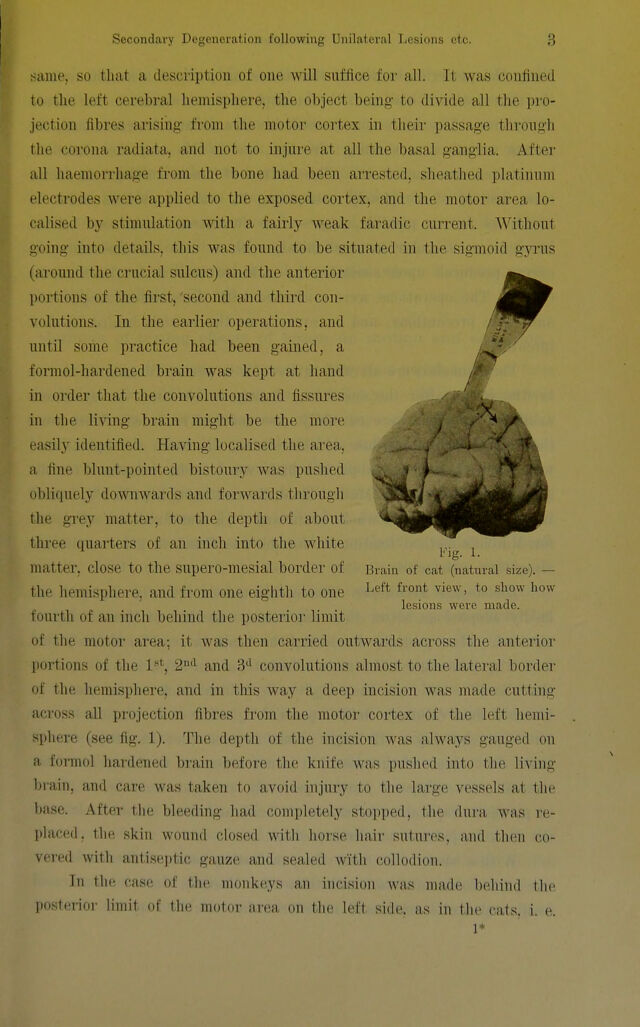
Secondary degeneration following unilateral lesions of the cerebral motor cortex / by Sutherland Simpson.
- Sutherland Simpson
- Date:
- 1902
Licence: In copyright
Credit: Secondary degeneration following unilateral lesions of the cerebral motor cortex / by Sutherland Simpson. Source: Wellcome Collection.
Provider: This material has been provided by The University of Glasgow Library. The original may be consulted at The University of Glasgow Library.
24/38 page 24
![ration of the crusta, and that, therefore these cells have some con- nection with the motor tract, but the extent and importance of this connection seems to have been overlooked by most neurologists. With regard to the question as to whether iibres from the pyra- midal tract pass directly to the cranial motor nuclei there seems to be much difference of opinion amongst investigators. Melius [14] in monkeys, Romanow [19] in dogs, Hoche [20], and Barnes [21] in the human subject, all using the Marchi method, say that they have been able to trace fibres from the degenerated pyramid to the motor nuc- lei, — most crossing the middle line to the nuclei of the opposite, a few passing to those of the same side. On the other hand, Boyce [13], Dejerine and Long [17] and others expressly state tliat they have failed to find any fibres passing to these nuclei. In several animals I have made serial sections from the upper limit of the mes- encephalon to the lower limit of the bulb, and in not one have I found degenerated fibres passing to any of the cranial motor nuclei. This is all the more surprising considering the ease with which such fibres could be traced of the anterior corpora quadi'igemina. No fib- res could be seen to pass backwards from the pyramidal tract, with the exception of those to the ant. corp. quad, till the lower levels of the pons were reached, and below this throughout the whole extent of the medulla oblongata, and not alone opposite any particular nuc- leus a very few fibres continued to be given off chiefly from the postero-mesial angle of the degenerated pyramid. Most crossed the middle line at once, disappearing in the formatio reticularis of the opposite side, comparatively few being lost in that of the same side. On comparing some of my sections with the figures given by Mura- toff [18] and by Romanow [19] in their papers (on which presumably these observers base the statement that fibres from the pyi-amid pass to the motor nuclei in the medulla and pons) I found that there was a very close resemblance. It will be seen from these figures, three of which I here reproduce, that as in the sections I examined, the fibres in question are not directed towards the grey matter in which the cranial nuclei are situated, but seem, for the short distance to which they can be traced, to pass more lateral-wards towards the](https://iiif.wellcomecollection.org/image/b21455727_0026.jp2/full/800%2C/0/default.jpg)