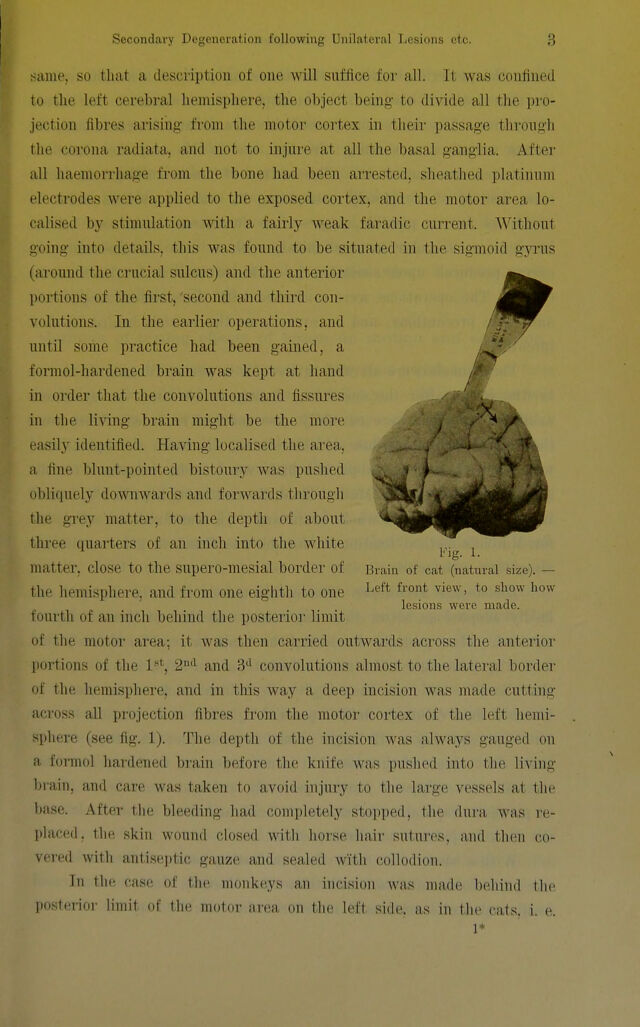
Secondary degeneration following unilateral lesions of the cerebral motor cortex / by Sutherland Simpson.
- Sutherland Simpson
- Date:
- 1902
Licence: In copyright
Credit: Secondary degeneration following unilateral lesions of the cerebral motor cortex / by Sutherland Simpson. Source: Wellcome Collection.
Provider: This material has been provided by The University of Glasgow Library. The original may be consulted at The University of Glasgow Library.
4/38 page 4
![along the posterior border of the ascending parietal convolution from the supero-mesial border of the hemisphere down almost to the fissure of Sylvius. The knife was pushed downwards and forwards into the corona radiata in a slanting direction, and in this way the whole left motor area was under-cut. This method of under-cutting the motor area, instead of completely extirpating it, was adopted in order to avoid, as far as possible, any serious functional disturbance of the hemisphere, vascular or mechanical, with a view to determine the effects produced upon sensation by a lesion limited to the Eolandic cortex. The operations were conducted with the strictest aseptic and antiseptic precautious, and in every case the wounds healed by first intention. The animals were allowed to live for a period ranging from two to five weeks after tlie operation, during which time the symptoms exhibited by them were carefully observed and recorded. They were then killed by an overdose of chloroform, the brain and spinal cord was removed, and those parts which were to be examined for de- generation were put into Miiller's fluid, the rest being kept in 5/(, formol. In the later cases the whole brain and cord was fixed in formol, but for Marchi's method fixation in formol was found to give results not altogether satisfactory. Histological Technique. The method most frequently employed, and finally adopted as better than any other, was tliat of Marchi slightly modified. After partially hardening the brain or cord in MiiUer's fluid or a 2°/o potassium bichromate solution for ten days, it was cut into thin slices — not more than ^Z,,.'''' or Vs^'* ich thick — and placed in Marchi's fluid (Miiller's fluid 2 parts, l/o osmic acid solution 1 part) for other ten days. If large excess is used (not less than twenty times the volume of the tissue) it is not necessary to change the fluid. Ground glass stoppered bottles perfectly air-tight must be employed to prevent evaporation of the osmic acid, and these should be kept in the dark to prevent its decomposition. With a view to increase the penetrating power of the osmic acid. Orr [2] recommends as a substitnte for Marchi's fluid a mixture ol' osmic and acetic acids, and in order to increase its rapidity of nction](https://iiif.wellcomecollection.org/image/b21455727_0006.jp2/full/800%2C/0/default.jpg)