Volume 1
Illustrations of British mycology, containing figures and description of the funguses of interest and novelty indigenous to Britain / By Mrs. T.J. Hussey.
- Hussey, Thomas John, Mrs, active 1820-1877.
- Date:
- 1847-1855
Licence: Public Domain Mark
Credit: Illustrations of British mycology, containing figures and description of the funguses of interest and novelty indigenous to Britain / By Mrs. T.J. Hussey. Source: Wellcome Collection.
9/462
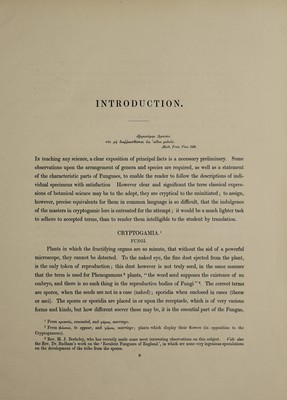
![INTRODUCTION. e^(pv(Tdfir]v ^porovs Tov pf) diappaicrdevras eis 'aidov poXeiv. ^sch. Fron. Vine. 248. In teaching any science, a clear exposition of principal facts is a necessary preliminary. Some observations upon the arrangement of genera and species are required, as well as a statement of the characteristic parts of Funguses, to enable the reader to follow the descriptions of indi¬ vidual specimens with satisfaction However clear and significant the terse classical expres¬ sions of botanical science may be to the adept, they are cryptical to the uninitiated; to assign, however, precise equivalents for them in common language is so difficult, that the indulgence of the masters in cryptogamic lore is entreated for the attempt j it would be a much lighter task to adhere to accepted terms, than to render them intelligible to the student by translation. CRYPTOGAMIA.^ FUNGI. Plants in which the fructifying organs are so minute, that without the aid of a powerful microscope, they cannot be detected. To the naked eye, the fine dust ejected from the plant, is the only token of reproduction; this dust however is not truly seed, in the same manner that the term is used for Phenogamous ^ plants, “ the word seed supposes the existence of an embryo, and there is no such thing in the reproductive bodies of Fungi ” The correct terms are spores, when the seeds are not in a case (naked); sporidia when enclosed in cases (thecae or asci). The spores or sporidia are placed in or upon the receptacle, which is of very various forms and kinds, but how different soever these may be, it is the essential part of the Fungus, * From KpvTTTos, concealed^ and -ya/uoy, marriage. 2 From (jidipeiv, to appear, and ydpos, marriage; plants which display their flowers (in opposition to the Cryptogamous). ^ Rev. M. J. Berkeley, who has recently made some most interesting observations on this subjeet. Vide also the Rev. Dr. Badham’s work on the ‘ Esculent Funguses of England in which are some very ingenious speculations on the development of the tribe from the spores. B](https://iiif.wellcomecollection.org/image/b30454773_0001_0009.jp2/full/800%2C/0/default.jpg)