National portrait gallery of eminent Americans: including orators, statesmen, naval and military heroes, jurists, authors, etc., etc (Volume 2).
- Evert Augustus Duyckinck
- Date:
- 1861-64
Licence: Public Domain Mark
Credit: National portrait gallery of eminent Americans: including orators, statesmen, naval and military heroes, jurists, authors, etc., etc (Volume 2). Source: Wellcome Collection.
Provider: This material has been provided by the National Library of Medicine (U.S.), through the Medical Heritage Library. The original may be consulted at the National Library of Medicine (U.S.)
26/726
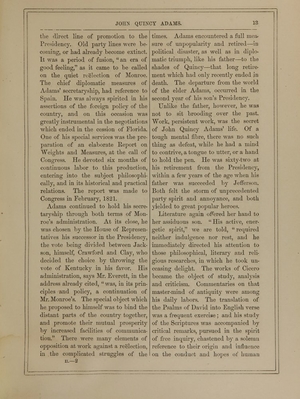
![life. His favorite science, astronomy, led to the frequent 'observation of the planets and stars; and his attention was also called to agriculture and hor- ticulture. He collected and planted the seeds of forest trees, and kept a record of their development; and, in the summer season, labored two or three hours daily in his garden. With these pursuits were combined sketches preparatory to a full biography of his father, which he then contemplated as one of his chief future employments.1 He was, however, again soon called into action, being elected, in November, 1830, by his district, to the House of Representatives. It was a novel spec- tacle—an ex-president of the United States sitting in the lower house, but it was fully in accordance with the spirit of our institutions, which honor all faithful servants of the public. Nor is it to be denied that at least equal talent may be called for, and equal influence exerted in the discharge of duties of public life, which to the eye of the world have a comparative inferiority of position. Power may be wielded by a representative which may govern the administration itself. There are many acts of our legislative bodies more potential than the simple acquies- cence of the Executive; as the origina- tor of a measure or line of policy must be of more consequence than the instru- ment which gives it effect. For more than sixteen years Adams labored at his seat in the House. He was the most punctual man of the assembly, a] ways on the alert; cool, resolute, even 1 Josiah Quincy'8 Biography, p. 175-6. pugnacious. There was scarcely a ques- tion, involving a point of morality, of national honor, or of literary and philo- sophical culture, on which his voice was not heard. He supported the de- mands of Jackson upon France; he asserted and successfully maintained the right of petition against vast obloquy and opposition; he was especially in- strumental in the establishment of the National Observatory, and the Smithso- nian Institution. A bare enumeration of his speeches, writings and addresses, would fill the space assigned to this sketch—lectures and addresses on points of law, government, history, biography and science, moral and social, local and national, before sena- tors and before youths, on anniversa- ries of towns, on eras of the State, eulogies on the illustrious dead, on Madison, Monroe, Lafayette, the oration at the Jubilee of the Constitution. As he had lived, so he died in har- ness. Death found him where he could have wished its approach, in the halls of Congress. His robust powers of body and mind had held out surpris- ingly, as his vigor, no less than his venerable appearance in the House, enforced an authority not always read- ily conceded to the persistence in unpopular appeals of the old man eloquent. He was approaching eighty: still in the exercise of his extraordinary faculties, when, in a recess of Congress, walking in the streets of Boston, in November, 1846, he was stricken by paralysis, from which, nevertheless, he recovered in time to take his seat in Congress early in the year. The House rose to greet him, and he was conducted](https://iiif.wellcomecollection.org/image/b21117093_0026.jp2/full/800%2C/0/default.jpg)


 No text description is available for this image
 No text description is available for this image
 No text description is available for this image