Annual report of the General Board of Commissioners in Lunacy for Scotland : 17th 1875
- Great Britain. General Board of Commissioners in Lunacy for Scotland.
- Date:
- 1875
Licence: Public Domain Mark
Credit: Annual report of the General Board of Commissioners in Lunacy for Scotland : 17th 1875. Source: Wellcome Collection.
276/298 (page 256)
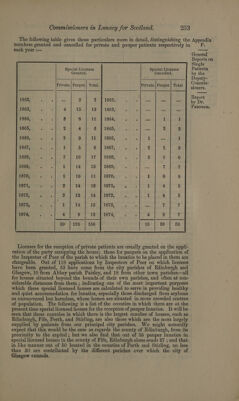
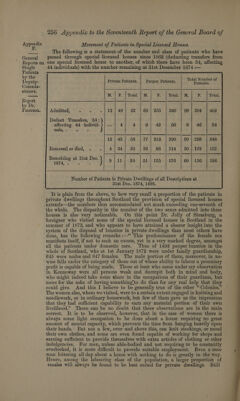
![Appendix Movement of Patients in Special Licensed Houses. The following is a statement of the number and class of patients who have General | passed through special licensed houses since 1862 (deducting transfers from Reports on One special licensed house to another, of which there have been 54, affecting Single 44 individuals) with the number remaining at 31st December 1874 :— Patients by the Deputy- Private Patients. Pauper Patients. igh ail of Commis- sioners. M F. | Total | M. F Total. | M. F Report pe by Dr. Paterson. Admitted, : ° -| 13 | 49} 62 | 85 | 255 | 340 | 98 | 804 Deduct Transfers, 54; affecting 44 individ- uals, . ¥ ; a a oe Removed or died, . 4|34] 88 | 26] 88 | 114 | 80 } 122 rn | rere | nm | | eee Remaining at 31st raha 9} 41 1874, . Number of Patients in Private Dwellings of all Descriptions at 31st Dec. 1874, 1496. It is plain from the above, to how very small a proportion of the patients in private dwellings throughout Scotland the provision of special licensed houses extends—the numbers thus accommodated not much exceeding one-seventh of the whole. The disparity in the number of the two sexes admitted into these houses is also very noticeable. On this point Dr. Jolly of Strasburg, a foreigner who visited some of the special licensed houses in Scotland in the summer of 1873, and who appears to have attained a clearer insight into the system of the disposal of lunatics in private dwellings than most others have done, has the following remarks :—“ This predominance of the female sex manifests itself, if not to such an excess, yet in a very marked degree, amongst all the patients under domestic care. Thus of 1492 pauper lunatics in the whole of Scotland, who at Ist January 1872 were under family guardianship, 645 were niales and 847 females. The male portion of them, moreover, in no- wise falls under the category of those out of whose ability to labour a pecuniary profit is capable of being made. Those at least who came under my observation in Kennoway were all persons weak and decrepit both in mind and body, who might indeed take some share in the occupations of their guardians, but more for the sake of having something*to do than for any real help that they could give. And this I believe to be generally true of the other “ Colonies.” The women also, whom we visited, were to a certain extent engaged in knitting and needlework, or in ordinary housework, but few of them gave us the impression that they had sufficient capability to earn any material portion of their own livelihood.” There can be no doubt that these observations are in the main correct. It is to be observed, however, that in the case of women there is always some light occupation to be done about a house requiring no great amount of mental capacity, which prevents the time from hanging heavily upon their hands. But not a few, over and above this, can knit stockings, or mend their own clothes, and some are even found capable of working for shops and earning sufficient to provide themselves with extra articles of clothing or other indulgencies. For men, unless able-bodied and not requiring to be constantly overlooked, it is more difficult. to provide suitable employment. Even a sane man loitering all day about a house with nothing to do is greatly in the way. Hence, among the labouring class of the population, a larger proportion of emales will always be found to be best suited for private dwellings. Still ©](https://iiif.wellcomecollection.org/image/b31856354_0276.jp2/full/800%2C/0/default.jpg)