No vaccine, no cure : HIV and AIDS in the United Kingdom : report : 1st report of session 2010-12 / Select Committee on HIV and AIDS in the United Kingdom.
- Great Britain. Parliament. House of Lords. Select Committee on HIV and AIDS in the United Kingdom.
- Date:
- 2011
Licence: Open Government Licence
Credit: No vaccine, no cure : HIV and AIDS in the United Kingdom : report : 1st report of session 2010-12 / Select Committee on HIV and AIDS in the United Kingdom. Source: Wellcome Collection.
20/152 page 16
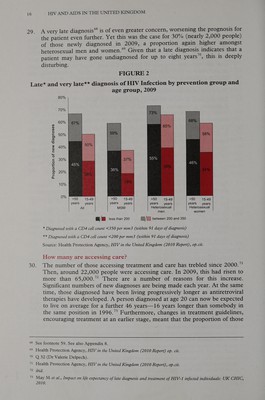
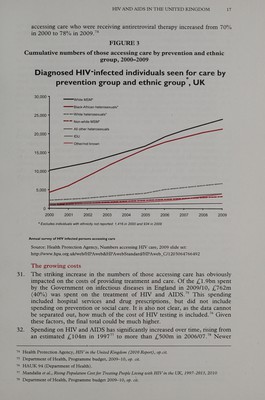
![A very late diagnosis” is of even greater concern, worsening the prognosis for the patient even further. Yet this was the case for 30% (nearly 2,000 people) of those newly diagnosed in 2009, a proportion again higher amongst heterosexual men and women.” Given that a late diagnosis indicates that a patient may have gone undiagnosed for up to eight years’, this is deeply disturbing. FIGURE 2 age group, 2009 80% 70% 60% 50% 40% 30% 20% Proportion of new diagnoses 10% 0 0% >50 15-49 >50 15-49 >50 15-49 >50 15-49 years years years years years years years years All Heterosexual Heterosexual men women \/|_] between 200 and 350 ** Diagnosed with a CD4 cell count <200 per mm3 (within 91 days of diagnosis) Source: Health Protection Agency, HIV in the United Kingdom (2010 Report), op.cit. How many are accessing care? The number of those accessing treatment and care has trebled since 2000.” Then, around 22,000 people were accessing care. In 2009, this had risen to more than 65,000.’* There are a number of reasons for this increase. Significant numbers of new diagnoses are being made each year. At the same time, those diagnosed have been living progressively longer as antiretroviral therapies have developed. A person diagnosed at age 20 can now be expected to live on average for a further 46 years—16 years longer than somebody in the same position in 1996.”* Furthermore, changes in treatment guidelines, encouraging treatment at an earlier stage, meant that the proportion of those See footnote 59. See also Appendix 8. Health Protection Agency, HIV in the United Kingdom (2010 Report) op. cit. Q 32 (Dr Valerie Delpech). Health Protection Agency, HIV in the United Kingdom (2010 Report), op.cit. ibid. May M et al., Impact on life expectancy of late diagnosis and treatment of HIV-1 infected individuals: UK CHIC, 2010.](https://iiif.wellcomecollection.org/image/b32222725_0020.jp2/full/800%2C/0/default.jpg)
 No text description is available for this image
 No text description is available for this image
 No text description is available for this image