The history and antiquities of London, Westminster, Southwark, and other parts adjacent ... Continued to the present time / by Thomas Wright.
- Thomas Allen
- Date:
- 1839
Licence: Public Domain Mark
Credit: The history and antiquities of London, Westminster, Southwark, and other parts adjacent ... Continued to the present time / by Thomas Wright. Source: Wellcome Collection.
67/504 page 51
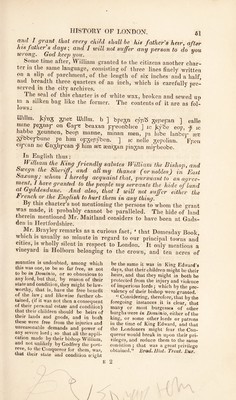
![and I grant that every child shall be his father's heir, after his father s days; and I will not suffer any person to do you wrong. God keep you. Some time after, William granted to the citizens another char- ter in the same language, consisting of three lines finely written on a slip of parchment, of the length of six inches and a half, and breadth three quarters of an inch, which is carefully pre- served in the city archives. The seal of this charter is of white wax, broken and sewed up in a silken bag like the former. The contents of it are as fol- lows^* Ulillm. jcynj gpet: Ulillm. b ] bpegn cypS jepepan ] ealle mine pejnajr on Cayz beaxan pjpeonblice ] ic jcybe eop, 'f ic habbe geunnen, beop manne, minan men, pa lube lanber mt: gybbefbune pe him oygepyben. ] ic nelle gepolian. Fpcu ciycan ne engliycan f him eer senigan pingan miybeobe. In English thus ; William the King friendly salutes William the Bishop, and bwegn the Sheriff', and all my thanes (or nobles) in East Saxony; whom [hereby acquaint that, pursuant to an agree- meid, I have granted to the people my servants the hide of land cU Gyddesdune. And also, that I will not suffer either the French or the English to hurt them in any thing. By this charters not mentioning the persons to whom the o-rant was made, it probably cannot be paralleled. The hide of^land therein mentioned Mr. Maitland considers to have been at Gads- den in Hertfordshire. Mr. Bray ley remarks as a curious fact, ‘ that Domesday Book, which IS usually so minute in regard to our principal towns and cities, is wholly silent in resect to London. It only mentions a vineyard in Hoi born belonging to the crown, and ten acres of munities is undoubted, among which this was one, to be so far free, as not to be in Dominio, or so obnoxious to any lord, but that, by reason of their state and condition, they might be Jaw- worthy, that is, have the free benefit of the law; and likewise further ob- tained, (if it was not then a consequent of their personal estate and condition) that their children should be heirs of their lands and goods, and in both these were free from the injuries and unreasonable demands and power of any severe lord ; so that all the appli- cation made by their bishop William, and not unlikely by Godfrey the pjort- reve, to the Conqueror for them, was, that their state and condition might be the same it was in King Edward’s days, that their children might be their heirs, and that they might in both be protected from the injury and violence of imperious lords ; which by the pre- valency of their bishop were granted. Considering, therefore, that by the foregoing instances it is clear, that many or most burgesses of other burghs were in Dominio, either of the king, or some other lords or patrons in the time of King Edward, and that the Londoners might fear the Con- queror would break in upon their pri- vileges, and reduce them to the same condition ; that was a great privilege obtained.” Brad. Hut. Treat. Bur.](https://iiif.wellcomecollection.org/image/b29310775_0067.jp2/full/800%2C/0/default.jpg)