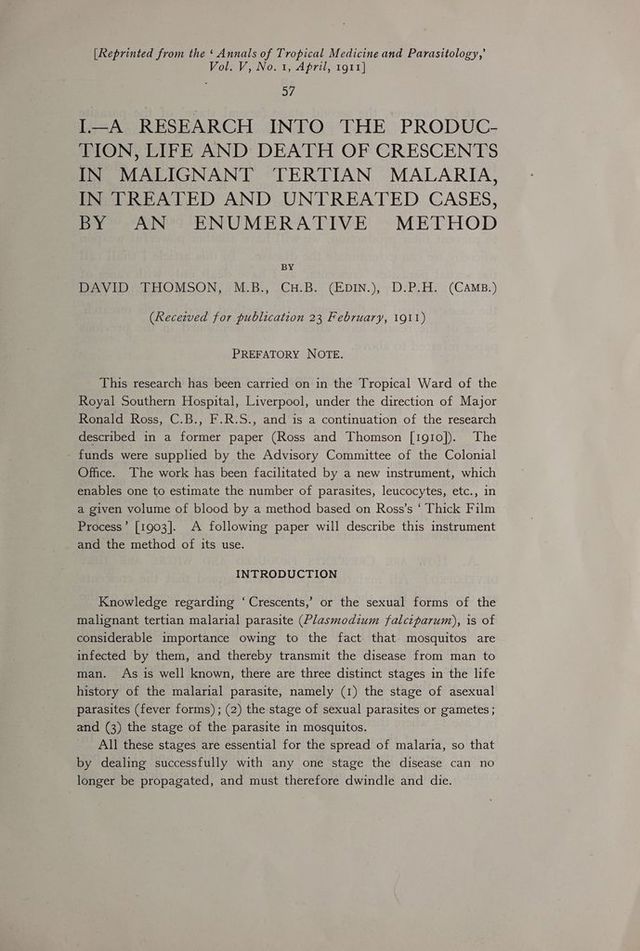
A research into the production, life and death of crescents in malignant tertian malaria, in treated and untreated cases, by an enumerative method ; The leucocytes in malarial fever : a method of diagnosing malaria long after it is apparently cured / by David Thomson.
- Thomson, D. (David)
- Date:
- 1911
Licence: Public Domain Mark
Credit: A research into the production, life and death of crescents in malignant tertian malaria, in treated and untreated cases, by an enumerative method ; The leucocytes in malarial fever : a method of diagnosing malaria long after it is apparently cured / by David Thomson. Source: Wellcome Collection.
13/54 page 67
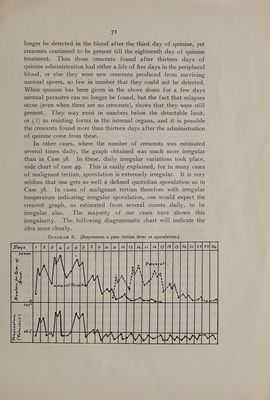
![the fever paroxysm and afterwards, it helps much to prevent the formation of crescents. The destructive action of quinine in these doses on the asexual spores is so powerful and rapid that one is surprised at the subsequent appearance of even a few crescents. If quinine is withheld till one or two days after the fever paroxysm and then given in the above daily doses, the crescents may still appear in large numbers—vzde Cases 20, 22, etc. This shows that when once the crescents have commenced to develop, the quinine does not then prevent them from reaching maturity and appearing in the peripheral blood on the tenth day or thereabout. I would therefore conclude that quinine in large daily doses, given during and after the fever paroxysm, diminishes the crescent-producing power of that paroxysm, not by acting on the crescents themselves, but indirectly by destroying the asexual spores from which the crescents are produced. However, if quinine be given in smaller doses, say five grains daily, or ten to twenty grains irregularly, then instead of the crescent production becoming less, there is evidence to show that it may become even more prolific. Thus in Case 18, crescents became much more numerous after quinine was administered in daily doses of five grains. This case with such treatment showed a very high crescent-producing power, the ratio of asexual spores to crescents being as eight is to one approximately. It is quite reasonable to suppose that in such cases, quinine given in small doses destroys only some of the asexual-spores, but enables the host to keep the disease under control, and to develop some resistance or immunity. In the consequence more crescents develop from the remaining parasites. Case 18 and others showed the presence of asexual parasites for many days during the administra- tion of quinine in doses of five grains daily. Quinine given continuously in daily doses of twenty to thirty grains, has never failed in our cases to reduce the crescents to numbers less than one per c.mm. of blood in a period not exceeding three weeks, vide chart of Case 49. This reduction of crescents by quinine has also been noted by Darling [1910]. E. ‘THE EFFECT OF METHYLENE BLUE ON CRESCENTS. It would appear from the careful investigation of six cases treated alone with methylene blue, that this drug in doses of twelve grains daily, given by mouth (pill form), though not so potent in destroying](https://iiif.wellcomecollection.org/image/b33445059_0013.jp2/full/800%2C/0/default.jpg)
 No text description is available for this image
 No text description is available for this image
 No text description is available for this image