A research into the production, life and death of crescents in malignant tertian malaria, in treated and untreated cases, by an enumerative method ; The leucocytes in malarial fever : a method of diagnosing malaria long after it is apparently cured / by David Thomson.
- Thomson, D. (David)
- Date:
- 1911
Licence: Public Domain Mark
Credit: A research into the production, life and death of crescents in malignant tertian malaria, in treated and untreated cases, by an enumerative method ; The leucocytes in malarial fever : a method of diagnosing malaria long after it is apparently cured / by David Thomson. Source: Wellcome Collection.
16/54 page 70
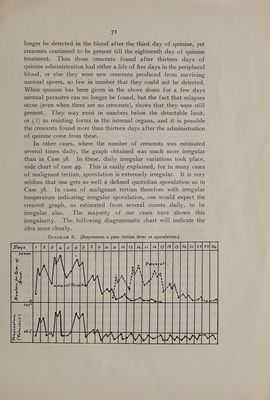
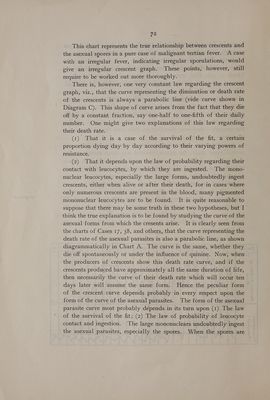
![do without its administration, yet this effect is not due to any direct destructive action on the crescents themselves. It is due indirectly to the destruction of the asexual spores from which the crescents are developed. The length of time that crescents will remain in the peripheral blood therefore depends upon the persistence of the asexual parasites. If immunity develops so strongly that the asexual parasites almost disappear, or if they are destroyed by quinine, then the crescents also will disappear in due course. In cases where immunity ,remains, but is only sufficient to keep the number of asexual parasites in check, crescents may continue almost indefinitely. Crescents have been observed to continue in the peripheral blood for eight weeks, Surveyor [1910]. Case 18, where the asexual source of supply was not destroyed by quinine till late, had crescents for forty-four days, and probably longer than this, as they were present when the case first came under our observation. Sufficient has been said to point out the fallacies regarding the duration of life of crescents. I must, however, once more refer to the chart of Case 38. Here the number of crescents per c.mm. of blood was estimated several times daily. The crescent graph obtained shows the great importance of making numerous observations, for had the numbers been estimated only once a day, the daily variation in the number of crescents would not have been noticed. Here we have a pure quotidian case of fever, resulting in quotidian outbursts of crescents into the peripheral circulation, each crescent outburst corresponding to a sporulation of the asexual parasites occurring ten days before. It is noticeable that the quinine in doses of thirty grains daily did not appreciably diminish the numbers of crescents till the tenth day after its administration. The number of crescents then diminished, rapidly at first and afterwards more slowly, for nine more days. This would seem to indicate that the quinine quickly destroyed the majority of the parasites of the asexual source, the remainder dying more slowly. The curve also clearly shows that the crescents die very quickly in the peripheral blood stream; a very marked fall occurs each day, but this fall is compensated for by a fresh brood each day. It is clear that but for this compensation the crescents would only remain in the peripheral blood for a very few days. Again it will be observed that although asexual parasites could no](https://iiif.wellcomecollection.org/image/b33445059_0016.jp2/full/800%2C/0/default.jpg)
 No text description is available for this image
 No text description is available for this image
 No text description is available for this image