A research into the production, life and death of crescents in malignant tertian malaria, in treated and untreated cases, by an enumerative method ; The leucocytes in malarial fever : a method of diagnosing malaria long after it is apparently cured / by David Thomson.
- Thomson, D. (David)
- Date:
- 1911
Licence: Public Domain Mark
Credit: A research into the production, life and death of crescents in malignant tertian malaria, in treated and untreated cases, by an enumerative method ; The leucocytes in malarial fever : a method of diagnosing malaria long after it is apparently cured / by David Thomson. Source: Wellcome Collection.
3/54 page 57
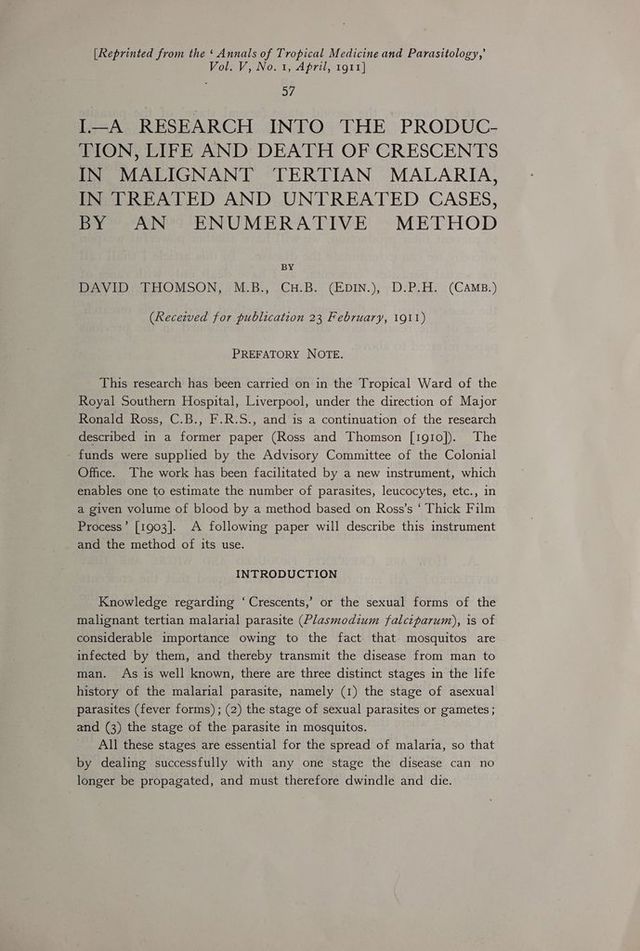
![[Reprinted from the ‘ Annals of Tropical Medicine and Parasitology,’ Volo, Now, April,-1911} 37 I—A RESEARCH INTO THE PRODUC- TION, LIFE AND DEATH OF CRESCENTS IN MALIGNANT TERTIAN MALARIA, IN TREATED AND UNTREATED CASES, BY AN ENUMERATIVE METHOD BY DAVID THOMSON, M.B., CH.B. (EDIN.), D.P.H. (CAMB.) (Recezved for publication 23 February, 1911) PREFATORY NOTE. This research has been carried on in the Tropical Ward of the Royal Southern Hospital, Liverpool, under the direction of Major Ronald Ross, C.B., F.R.S., and is a continuation. of the research described in a former paper (Ross and Thomson [1gI0]). The funds were supplied by the Advisory Committee of the Colonial Office. The work has been facilitated by a new instrument, which enables one to estimate the number of parasites, leucocytes, etc., in a given volume of blood by a method based on Ross’s ‘ Thick Film Process’ [1903]. A following paper will describe this instrument and the method of its use. INTRODUCTION Knowledge regarding ‘Crescents,’ or the sexual forms of the malignant tertian malarial parasite (Plasmodium falciparum), is of considerable importance owing to the fact that. mosquitos are infected by them, and thereby transmit the disease from man to man. As is well known, there are three distinct stages in the life history of the malarial parasite, namely (1) the stage of asexual parasites (fever forms); (2) the stage of sexual parasites or gametes ; and (3) the stage of the parasite in mosquitos. All these stages are essential for the spread of malaria, so that by dealing successfully with any one stage the disease can no longer be propagated, and must therefore dwindle and die.](https://iiif.wellcomecollection.org/image/b33445059_0003.jp2/full/800%2C/0/default.jpg)