A research into the production, life and death of crescents in malignant tertian malaria, in treated and untreated cases, by an enumerative method ; The leucocytes in malarial fever : a method of diagnosing malaria long after it is apparently cured / by David Thomson.
- Thomson, D. (David)
- Date:
- 1911
Licence: Public Domain Mark
Credit: A research into the production, life and death of crescents in malignant tertian malaria, in treated and untreated cases, by an enumerative method ; The leucocytes in malarial fever : a method of diagnosing malaria long after it is apparently cured / by David Thomson. Source: Wellcome Collection.
7/54 page 61
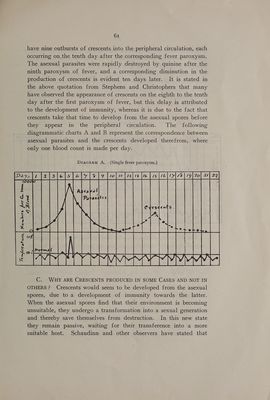
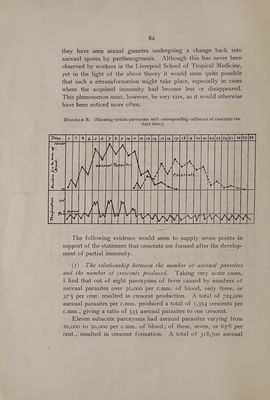
![have nine outbursts of crescents into the peripheral circulation, each occurring on.the tenth day after the corresponding fever paroxysm. The asexual parasites were rapidly destroyed by quinine after the ninth paroxysm of fever, and a corresponding diminution in the production of crescents is evident ten days later. It is stated in the above quotation from Stephens and Christophers that many have observed the appearance of crescents on the eighth to the tenth day after the first paroxysm of fever, but this delay is attributed to the development of immunity, whereas it is due to the fact that crescents take that time to develop from the asexual spores before they appear in the peripheral circulation. The following diagrammatic charts A and B represent the correspondence between asexual parasites and the crescents developed therefrom, where only one blood count is made per day. DIAGRAM A. (Single fever paroxysm.) eee 2) 3 els ani is [a [ro] ea [ae] 3 [ie | vail te [41 >| eal 20] i] 22 1000 J iY <x ac3¢ “uy & ran a 5 3 2 iii | ET C. WHY ARE CRESCENTS PRODUCED IN SOME CASES AND NOT IN OTHERS? Crescents would seem to be developed from the asexual spores, due to a development of immunity towards the latter. When the asexual spores find that their environment is becoming unsuitable, they undergo a transformation into a sexual generation and thereby save themselves from destruction. In this new state they remain passive, waiting for their transference into a more suitable host. Schaudinn and other observers have stated that 7< mherature.](https://iiif.wellcomecollection.org/image/b33445059_0007.jp2/full/800%2C/0/default.jpg)
 No text description is available for this image
 No text description is available for this image
 No text description is available for this image