Guide to the galleries of mammalia (mammalian, osteological, cetacean) in the Department of Zoology of the British Museum (Natural History).
- British Museum (Natural History). Department of Zoology.
- Date:
- 1892
Licence: Public Domain Mark
Credit: Guide to the galleries of mammalia (mammalian, osteological, cetacean) in the Department of Zoology of the British Museum (Natural History). Source: Wellcome Collection.
100/142 page 88
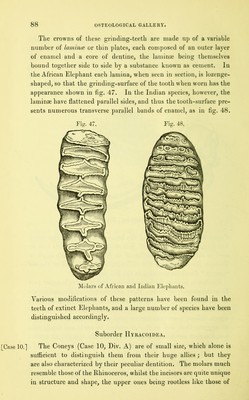
![The crowns of these grinding-teeth are made up of a variable number of lamime or thin ])lates, each composed of an outer layer of enamel and a core of dentine, the laminee being themselves bound together side to side by a substance known as cement. In the African Elephant each lamina, when seen in section, is lozenge- shaped, so that the grinding-surface of the tooth when worn has the appearance shown in fig. 47. In the Indian species, however, the laminae have flattened parallel sides, and thus the tooth-surface pre- sents numerous transverse parallel bands of enamel, as in fig. 48. Fi. 47. Fig. 48. Molars of African and Indian Elephants. Various modifications of these patterns have been found in the teeth of extinct Elephants, and a large number of species have been distinguished accordingly. Suborder IIyracoidea. [Case 10.] The Coneys (Case 10, Div. A) are of small size, which alone is sutficient to distinguish them from their huge allies; but they are also characterized by their peculiar dentition. The molars much resemble those of the Rhinoceros, whilst the incisors are quite unique in structure and shape, the upper ones being rootless like those of](https://iiif.wellcomecollection.org/image/b28122574_0100.jp2/full/800%2C/0/default.jpg)