Guide to the galleries of mammalia (mammalian, osteological, cetacean) in the Department of Zoology of the British Museum (Natural History).
- British Museum (Natural History). Department of Zoology.
- Date:
- 1892
Licence: Public Domain Mark
Credit: Guide to the galleries of mammalia (mammalian, osteological, cetacean) in the Department of Zoology of the British Museum (Natural History). Source: Wellcome Collection.
102/142 page 90
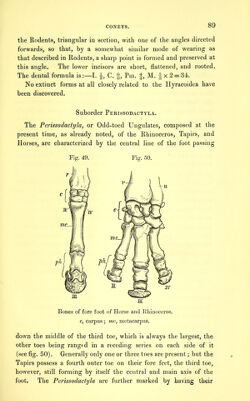
![[Case 10.] [Case 11.] [Cases 11 c'C 12.] premolar and molar teeth in one unbroken series, the posterior })remolars much resembling the true molars in shape and size. The dorsal and lumbar vertebrse together number at least twenty- two; and, as in all other Ungulates, clavicles are entirely absent. The three existing families of this Suborder, the Rhinocerotida, Tapiridce, and Equidce, are sharply separated by the structure of their molar teeth and by the numbers of their toes; these families are, however, very closely connected by numerous intermediate fossil forms, the majority of which have been found in North America. Such are the Lophiodontidce, the oldest Perissodactyles, from the Lower and Middle Eocene, allied to the Tapirs; and the Hijracodontidce,Macraucheniidce, Chalicotheriid(B^'dM\\. Palceotheriida, all more or less allied to Rhinoceros, but showing, the further we go back in time, a closer relationship one to another. These various fossil forms are described in the Guide to the Geological Galleries, pp. 21-23. The Rhinoceroses, of which a remarkably fine series of skeletons is placed in the centre of the Gallery, with skulls in Case 10, are characterized by the thickness and solidity of their bones, by the structure of their molar teeth, and by the enlargement of their nasal bones to serve as supports for the external horns. Incisor teeth are entirely wanting in the adults of the African species; but in the Indian there is a pair of large ones above, and two large and two small ones below. Of the specimens exhibited the most noteworthy are the skeleton of the Indian Rhinoceros {R. unicornis), and the two fine skulls of the White Rhinoceros [R. simus), by far the largest of the group, ])laced in the front of Case 10. The Ta])irs (Case 11, Divs. A-D) present almost the same osteological characters as their ancestors, which are found fossil in deposits of Upper Miocene age; they belong therefore to one of the oldest existing types of Mammals. Their molar teeth have two simple transverse crests on their crowns, very different from the highly com})lex enamel foldings of the teeth of Rhinoceroses and Horses. Their nasal bones are small; their toes four in number on the fore, and three on the hind feet. The Horses {Equidce) (Case 11, Divs. E and E, and Case 12) of the present day consist of animals in which the gradual loss of the outer digits in the feet has proceeded further than in any other](https://iiif.wellcomecollection.org/image/b28122574_0102.jp2/full/800%2C/0/default.jpg)