Guide to the galleries of mammalia (mammalian, osteological, cetacean) in the Department of Zoology of the British Museum (Natural History).
- British Museum (Natural History). Department of Zoology.
- Date:
- 1892
Licence: Public Domain Mark
Credit: Guide to the galleries of mammalia (mammalian, osteological, cetacean) in the Department of Zoology of the British Museum (Natural History). Source: Wellcome Collection.
132/142 page 120
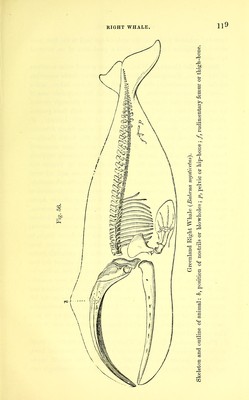
![]20 executed coloured model, on the scale of one inch to the foot, pre- sented by Captain David Gray, gives a good idea of its external appearance. Besides the Greenland AVhale there are several other members of the genus, distinguished from it by having heads somewhat smaller in proportion to the body, and with shorter baleen, and a larger number of vertebrae. These inhabit the temperate seas of both northern and southern hemispheres; and although divided by zoologists into several species, in accordance with their geogra- phical distribution—B. hiscaijensis, of the North Atlantic; B. japonica, of the North Pacific; B. australis, of the South Atlantic ; and B. antipodamm and novm-zelandice, of the South Pacific— their distinctive characters, if any, have never been accurately made out. The first named was the Whale formerly regularly hunted by whalers from the Basque sea-ports of France and Spain, and the main source of supply of w'halebone and oil until the discovery of the Greenland Whale in the seventeenth century. It therefore became extremely rare, but owing to the diversion of the whaler^s attention to the larger and more profitable Arctic species, it has of late years become again rather more numerous. The skeleton of a male specimen obtained from the coast of Iceland has lately been added to the collection. A mass of united cervical vertebrae, dredged from the bottom of the sea near Lyme Kegis, in 1853, probably also belongs to this species. The skeleton from New Zealand (labelled Balcena australis), a not quite full-grown animal, exhibited in the Gallery, shows how closely related the two sj)ecies are. None of the Bight Whales exceed 50 feet in length. JSeobalana. Two skeletons (adult and young) of a very remark- able Whale of small size (less than 25 feet), from New Zealand and Australia, of wdiich very little is as yet known, are placed on the left side of the room, near the windows. Besides some great peculiarities in the form of its bones, this species is distinguished by its very long, slender, elastic baleen, whick is nearly white in colour, with a dark external border. Rhachiariectes. The Grey Whale of the North Pacific, of which a skeleton is exhibited, combines the small head, elongated form, and narrow pectoral fin of Balcenoptera with the smooth throat and absence of the dorsal fin of Balcena. It is an exceedingly rare](https://iiif.wellcomecollection.org/image/b28122574_0132.jp2/full/800%2C/0/default.jpg)