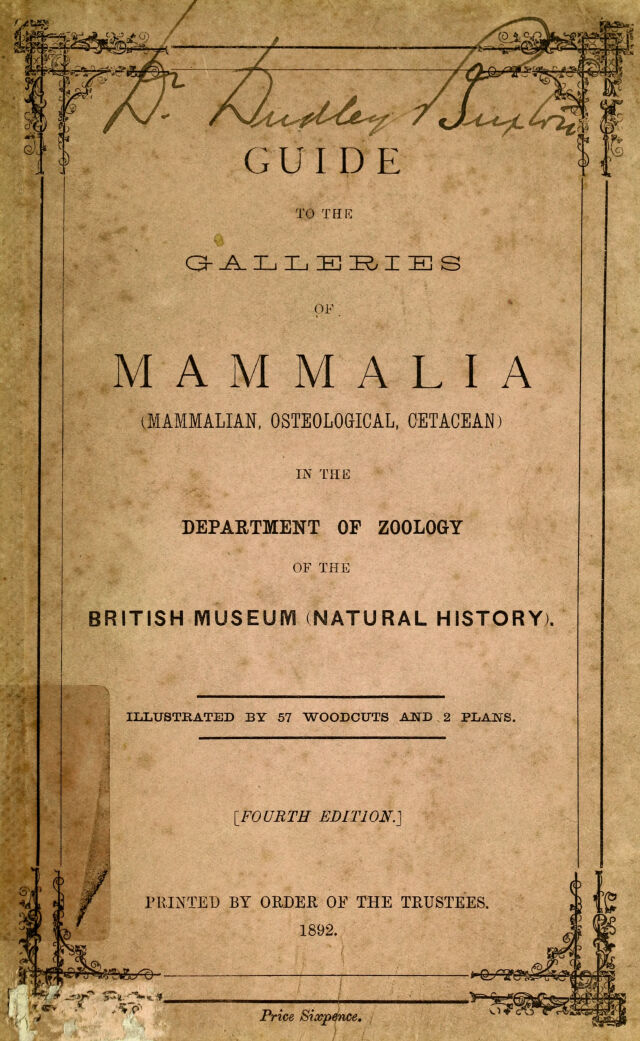
Guide to the galleries of mammalia (mammalian, osteological, cetacean) in the Department of Zoology of the British Museum (Natural History).
- British Museum (Natural History). Department of Zoology.
- Date:
- 1892
Licence: Public Domain Mark
Credit: Guide to the galleries of mammalia (mammalian, osteological, cetacean) in the Department of Zoology of the British Museum (Natural History). Source: Wellcome Collection.
14/142 page 2
![o on the earth, and sufficiently distinct from each other to be regarded by zoologists as species, has been estimated at about 3000, and there are doubtless many, especially among those of smaller size, still to be discovered. Mammals make their first appearance as far back as the Triassic or carl}'^ Mesozoic period, a few minute teeth, representing three small species, having been found in the lihietic beds of Germany and England. Later than these are the early Jurassic or Middle Mesozoic Mammals, found at Stonesfield in Oxfordshire, where several more or less complete lower jaws have been discovered, such as those named Amphltherium and Phascolotheriumj^\xi'Q(\. in the Geological Guide, p. 77. In Upper Jurassic times also a very large number of small mammals must have lived in this country, as evidenced by remains found at Swanage, now exhibited in the Palaeontological Gallery. Of the exact affinities of these Mesozoic Mammals it is almost impossible to form an idea ; but there can be little doubt that their nearest living allies are the jMarsupials, that is Didelphiau Mammals, in which the young are brought forth in an embryonic condition, completing their development in a pouch formed of the external integuments of the mother. To this day ^Marsupials show the same division into two groups, according to their dentition, which is observed in the ancient Swanage genera—Plagiaulax, as figured in the Geological Guide, representing the modern dipro- todont *, and the others the polyprotodont * Marsupials. At the commencement of the Tertiary jieriod Mouodelphian Mammals were already abundant, many of them resembling living species—a fact which shows how imperfect is our knowledge of the intermediate time during which all these forms must have been gradually developed fiom their Mesozoic ancestors. Thus the Eocene, the earliest of the Tertiary periods, has yielded remains of Bats, Insectivores, Carnivores, Kodentia, many Ungulates, Sirenia, and Cetacea. The Mammals of the ]\Iiocene, Pliocene, and Pleistocene periods, for which the Visitor is referred to the Geological Gufde, have increased in number and variety to the jircsent day; hut, at least for those that dwelt on the land, the maximum of size has long For the explanation of these terms see p. 90.](https://iiif.wellcomecollection.org/image/b28122574_0014.jp2/full/800%2C/0/default.jpg)